
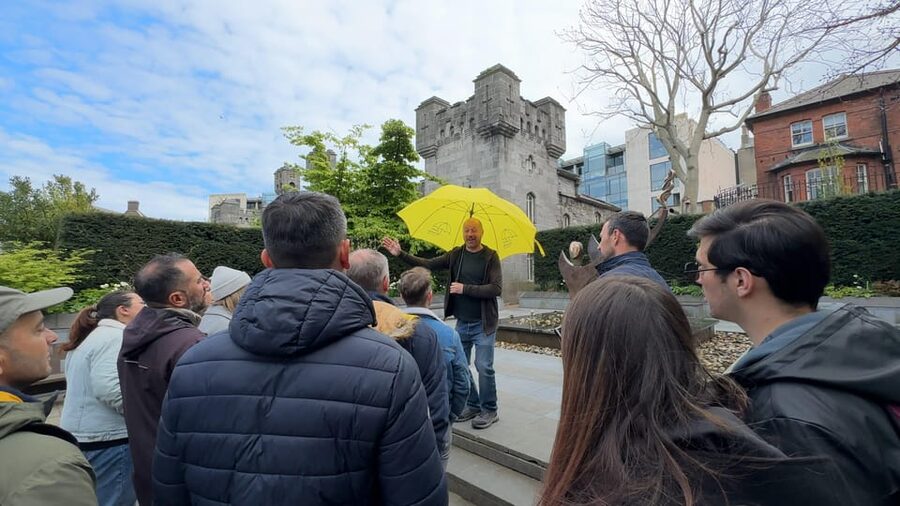
Reviewed · DUBLIN CITY WALKING TOURS
Dublin: Bucket List Sights Walking Tour
Dublin’s story unfolds in a compact old center on this two-hour walking tour, from Viking Christchurch Cathedral to the front gate of Trinity College. Along the way, you’ll pass cathedrals, castle courtyards, Georgian banks, lively pubs, and the river that shaped the city.
I like the way the route links big sights to the people behind them, including Jonathan Swift, Sir Benjamin Lee Guinness, Henry Roe, Michael Collins, and Molly Malone. I also like the personal touch from guide Peter, who answers questions, offers ideas for the rest of your stay, and can adjust his English to suit your level. The one drawback is the brisk schedule: two hours covers a lot, but you won’t have time for full visits inside every major sight.
Key points to know before you book
- Viking beginnings: Christchurch Cathedral traces its story to a Viking wooden church built about a thousand years ago.
- A clear city overview: The walk connects Dublin’s Celtic, Viking, Norman, British, and modern Silicon Docks chapters.
- Peter’s adaptable guiding: He can adjust his English to your level and answer questions along the way.
- No long indoor visits: You see the outside of the cathedrals, castle, and Trinity College, but the tour does not include entry to their exhibitions.
- A useful first-day route: The walk begins and ends near Christchurch, making it easy to continue exploring afterward.
- Good value at $19: For a small-cost introduction to Dublin’s central sights, the price is hard to fault.
Christchurch Cathedral and Dublin’s Viking beginning
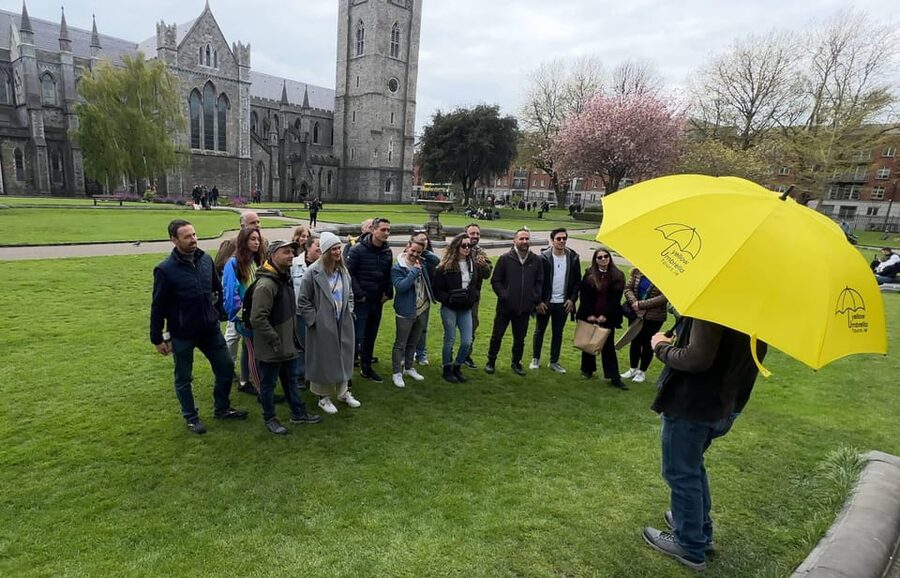
Meet your guide across from Christchurch Cathedral, outside the Bull and Castle. Look for the yellow umbrella. This is a simple meeting point in the old center, but give yourself enough time to find the exact spot, especially if you are arriving by taxi or walking from another part of town.
Christchurch is the right place to begin because Dublin’s earliest chapters are close beneath your feet. The first church on this site was built in wood by Vikings about a thousand years ago. The Normans later rebuilt it in stone, and the building you see today also carries the mark of a major 19th-century restoration.
Henry Roe, a wealthy whiskey distiller, paid for the spectacular Victorian Gothic work you see now. That detail helps turn the cathedral from a pretty facade into part of Dublin’s commercial story. Religion, trade, conquest, and private money all shaped the city.
You should expect to admire Christchurch from outside rather than spend time on a full interior visit. That matters if you want to see the cathedral nave, crypt, or other paid attractions. If your main goal is to learn how Dublin’s oldest center fits together, the exterior stop works well. If you want detailed architecture or quiet time inside, plan a separate visit.
More Dublin walking tours:
- Dublin Highlights and Hidden Gems Guided Walking Tour
★ 5.0 · 6,020 reviews - Dublin: Highlights and Hidden Gems Walking Tour
★ 4.9 · 2,140 reviews - 1916 Rebellion Walking Tour
★ 5.0 · 1,605 reviews
St. Patrick’s Cathedral and the city’s literary side
The next major stop is St. Patrick’s Cathedral, Dublin’s national cathedral and a place closely tied to the city’s identity. It carries the name of Ireland’s patron saint, whose story includes the famous tale of driving snakes from the island.
The cathedral is also the burial place of Jonathan Swift, former dean and author of Gulliver’s Travels. That connection gives the stop a literary edge. Dublin’s past is not only about kings, bishops, and military power. It is also about writers who used wit and satire to describe the world around them.
The building was restored in the 1860s with money from Sir Benjamin Lee Guinness. As at Christchurch, the point is not simply to look at old stone. You begin to see how private fortunes helped preserve Dublin’s major churches.
I like this part of the route because it gives you several useful layers in a short distance: religion, literature, architecture, and civic pride. You may want to return later for a proper interior visit, since the walking tour is designed to keep moving rather than provide a long examination of the cathedral.
Dubh Linn Garden and Dublin Castle’s two courtyards
From St. Patrick’s, the route continues to Dubh Linn Garden and the Chester Beatty Library. The name Dubh Linn means black pool, and it is tied to the old Viking harbor where longboats were moored after arriving in Dublin roughly twelve hundred years ago.
This is a good pause in the story. You are no longer hearing only about buildings. You are standing in an area that helps explain why Dublin formed here in the first place. Water, defense, trade, and access to the river all mattered.
The tour then moves through both the lower and upper courtyards of Dublin Castle. The architecture changes as you walk, with medieval elements beside Georgian additions. That mixture mirrors the complicated role of the castle itself.
For about 700 years, Dublin Castle served as the center of British government in Ireland. In 1922, it was handed over to Michael Collins and the Irish Free State after independence. That political shift is one of the key moments in modern Irish history, and the castle makes it easier to picture the setting where power changed hands.
The courtyards are especially useful for first-time visitors because you can read Dublin’s history in the buildings around you. The stop remains mainly an outdoor orientation, so you should not book this tour expecting a full castle tour or extended time inside its rooms.
Temple Bar, from Tudor streets to pub life
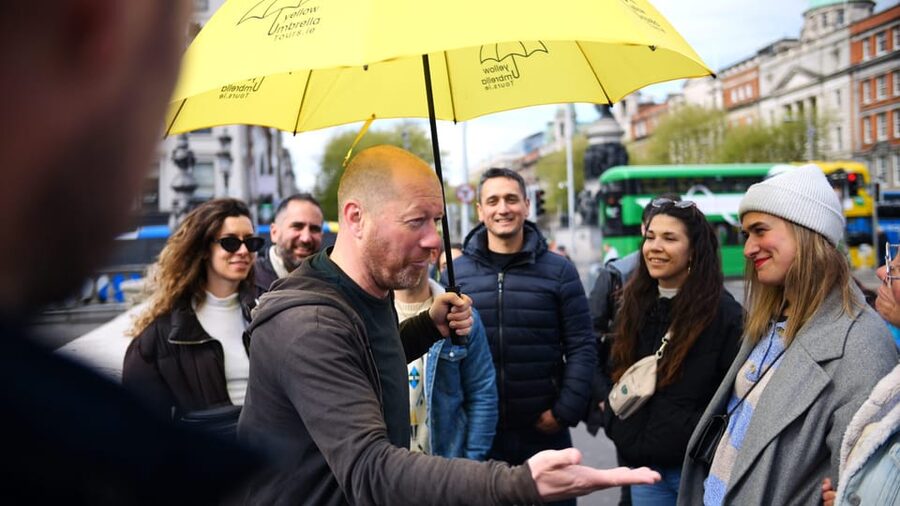
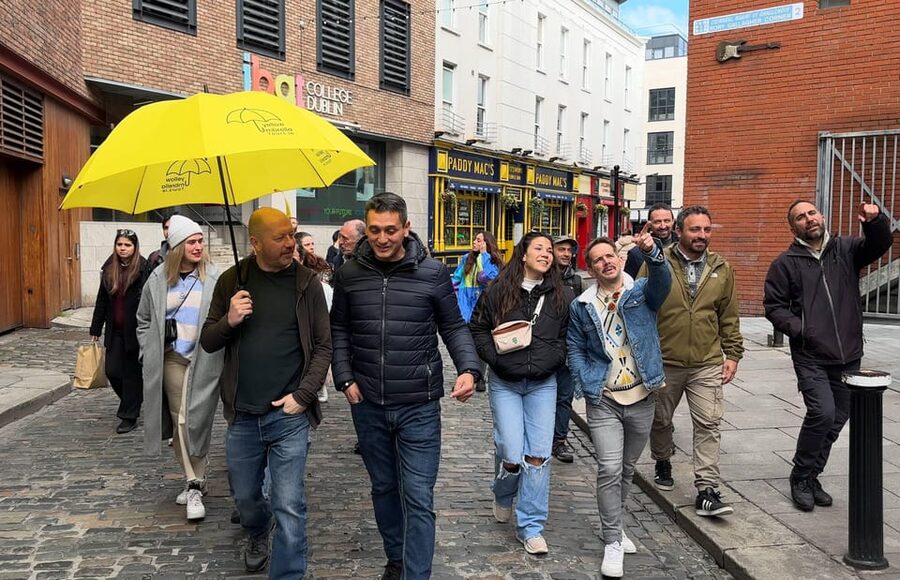
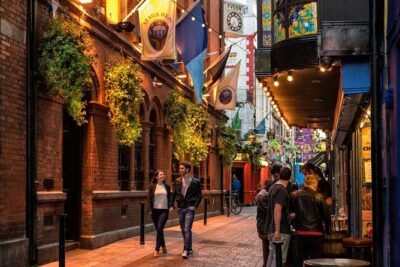
Temple Bar is usually the part of Dublin most familiar to first-time visitors. Today it is known for pubs, live music, and nightlife, but the district also occupies one of the oldest parts of the city. Its roots reach back to the Tudor conquest in the 16th century.
The tour gives you a look at Temple Bar as both a historic quarter and a social center. That balance is useful. It is easy to reduce the area to colorful pubs and music, but the streets carry centuries of change beneath the modern entertainment trade.
I like that the stop is not treated as the whole of Dublin. Temple Bar can feel busy, commercial, and expensive compared with quieter streets nearby. You will see the lively side of the city, but the guide also places it in the longer story of conquest, settlement, and urban growth.
If you want to return after the walk, you’ll have a better sense of where Temple Bar fits among the castle, river, and central shopping streets. The route itself does not promise a pub stop or a live performance, so bring that expectation down to a street-level introduction.
A completely different kind of day out of Dublin:
- Dublin to Cliffs of Moher, including Wild Atlantic Way and Galway
★ 5.0 · 23,331 reviews - From Dublin: Cliffs of Moher, Burren & Galway City Day Tour
★ 4.8 · 18,888 reviews - Dublin: Guinness Storehouse Entry Ticket
★ 4.6 · 16,863 reviews - Dublin to Cliffs of Moher, Burren, Wild Atlantic Way, Galway Tour
★ 5.0 · 12,924 reviews
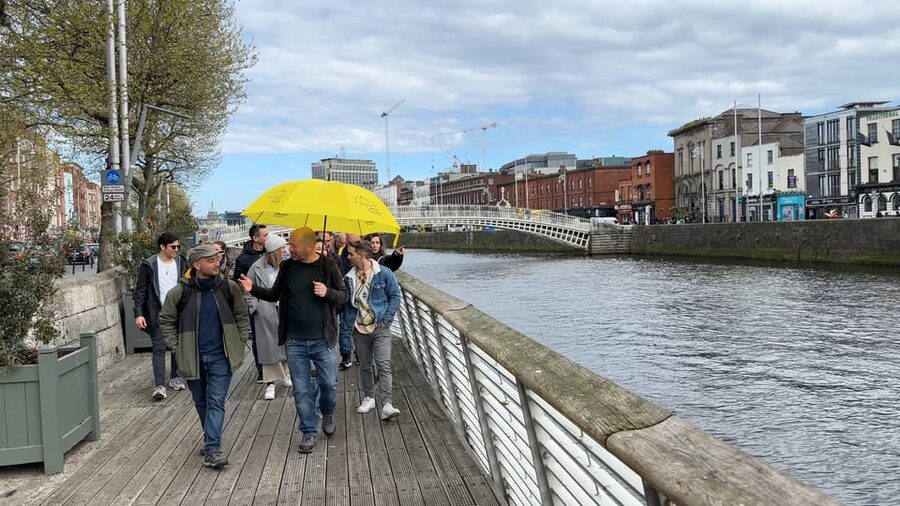
The Liffey, Ha’Penny Bridge, and a north-side view
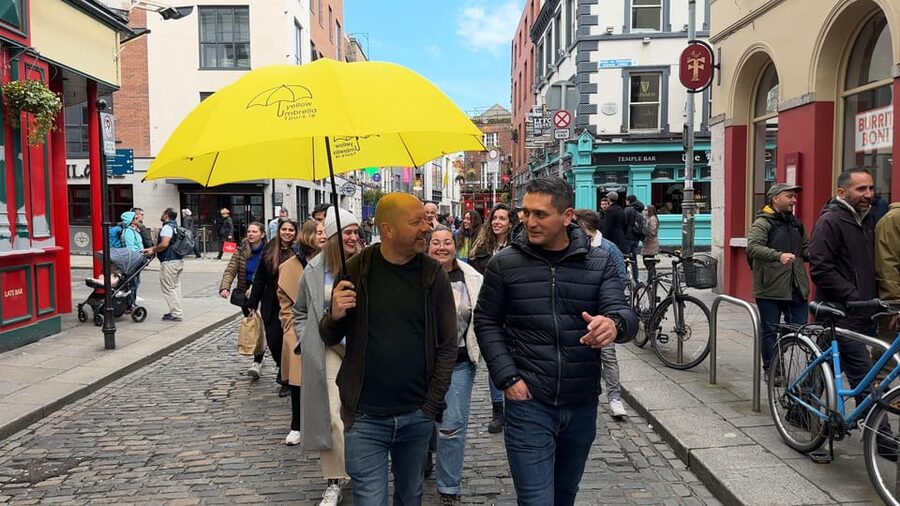
The walk crosses the River Liffey to Dublin’s north side. From here, the guide looks back across the city’s story, from the original Celtic settlement about 2,100 years ago to the modern development of the Silicon Docks.
That wide time span is one of the tour’s strongest ideas. Dublin is not a museum frozen in the past. The city has been shaped by Celts, Christians, Vikings, Normans, English rule, Irish independence, and 21st-century American influence in technology and business.
You then cross back over the Ha’Penny Bridge, one of Dublin’s best-known crossing points. The route continues through Merchant’s Arch and onto Crown Alley, where you consider Central Plaza, Sam Stephenson’s large brutalist office building.
This section offers a welcome change from churches and historic government buildings. It shows you the city’s more recent architecture and its willingness to put bold modern structures beside older streets. You may not love Central Plaza’s heavy concrete style, but it gives the walk a useful architectural argument: Dublin’s character comes from contrast, not one fixed look.
College Green and Dublin’s Georgian power center
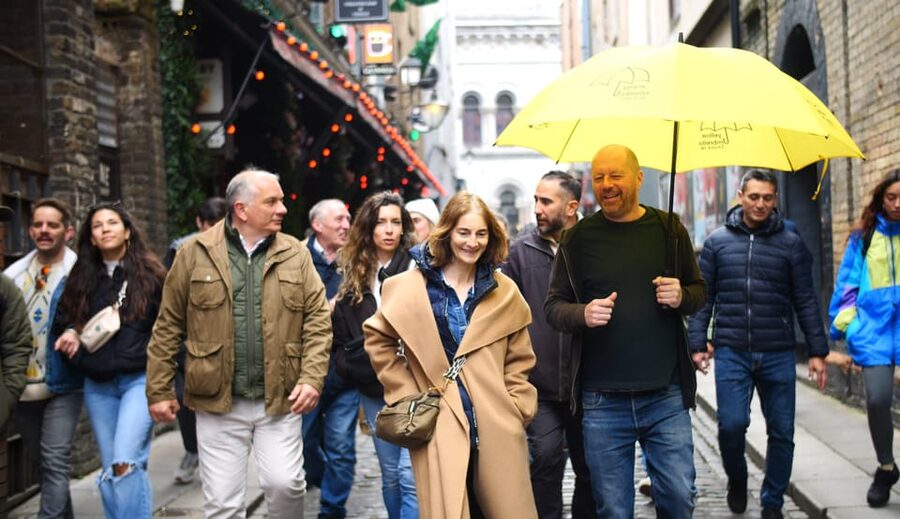
At College Green, the focus shifts to Dublin’s Georgian architecture and its former role as a center of finance and government. The banks and parliamentary buildings here reflect a period when Dublin saw itself as the second city of the British Empire.
That phrase carries political weight. The handsome facades are not just decorative background. They represent wealth, administration, and a Dublin elite whose power was tied to the wider British system.
This is one of the best sections for understanding how the city looked before independence. The route has already shown you Viking beginnings, medieval religion, British rule, and modern business. At College Green, those themes come together in a formal urban setting.
The walk does not turn into a detailed architectural lecture, but the guide gives you a framework for noticing the buildings. Look up at the stone fronts, compare the formal Georgian style with the rougher medieval traces elsewhere, and consider how close the financial and political centers were to the river and castle.
Molly Malone and the finish at Trinity College
No short introduction to Dublin would feel complete without Molly Malone. You’ll see the statue outside St. Andrew’s Church, where the famous fishmonger has become one of the city’s favorite characters.
The statue is a quick stop, but it works as a lighter ending after the heavier subjects of conquest, government, religion, and independence. Molly Malone also shows how Dublin turns songs, legends, and local characters into part of its public identity.
The walk finishes outside Trinity College, home to the famous Book of Kells exhibition. This is a smart endpoint. Trinity is one of Dublin’s biggest draws, and you can continue into the college or book a separate visit after the tour.
Keep in mind that the walk ends at the front gate, not inside the Book of Kells exhibition. That is both a limitation and a useful advantage. You get a clear introduction before deciding how much time you want to spend at Trinity, rather than rushing through the exhibition as one small piece of a packed schedule.
What $19 gets you in two hours
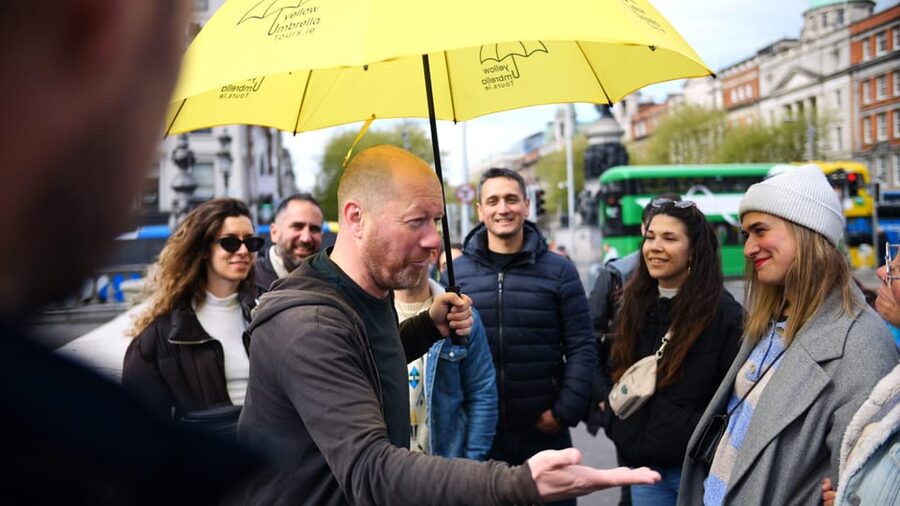
At $19 per person, this is a low-cost way to cover the main center without arranging your own route. The value comes from the connections between sights. You are not simply ticking off Christchurch, St. Patrick’s, Dublin Castle, Temple Bar, and Trinity College. You are hearing how each place fits into the next chapter of Dublin’s story.
The tour is especially good value if you are visiting Dublin for the first time, have only a short stay, or want help getting your bearings on day one. It can save you from walking past major buildings without understanding why they matter.
The price does not include entry to the cathedral interiors, the Chester Beatty Library, Dublin Castle rooms, or the Book of Kells exhibition. If you want full access to those sights, budget extra time and admission costs separately.
A two-hour route also means the pace matters. The walk covers a large number of stops, so you should wear comfortable shoes and expect short explanations rather than long pauses. The tour is wheelchair accessible, which is useful on a route that includes several major public areas, though the experience still involves continuous city walking.
Peter’s personal approach to the walk
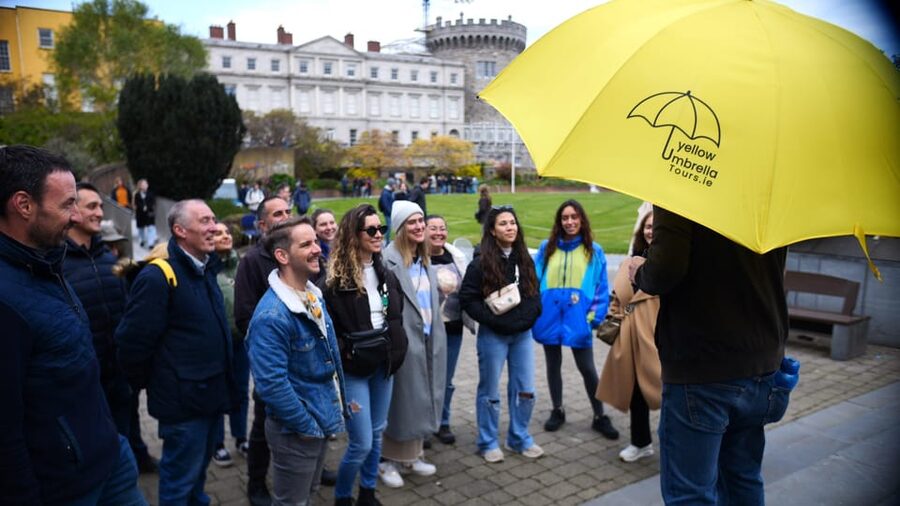
Guide Peter is worth noting because the experience is not presented as a fixed speech. He can adjust his English to your level, which helps if English is not your first language. He also makes room for questions and gives suggestions about what to do and where to go during the rest of your stay.
That makes the tour more useful than a simple historical recital. You can ask about a building that catches your eye, clarify a point about Irish independence, or seek ideas for your next stop.
The personal style also suits visitors who want a gentle introduction rather than a dense academic lecture. At the same time, the amount of information may feel substantial for anyone who prefers a slow, quiet walk with plenty of photo time. If you want to stop often, tell the guide early so you can judge the pace together.
Who should book this Dublin walk?
I would choose this tour if you want a compact first look at Dublin’s old center and prefer history with your sightseeing. It suits solo visitors, couples, families with older children, and anyone who wants a local guide to connect the landmarks.
It is also a good fit if your English is at an intermediate level, since Peter can adapt his delivery. The route offers enough variety to hold your attention: cathedrals, gardens, castle courtyards, pubs, bridges, modern offices, Georgian buildings, a famous statue, and Trinity College.
I would not choose it as your only activity if your priority is going inside every major attraction. You will need separate time for the Book of Kells, cathedral interiors, the Chester Beatty Library, and the rooms at Dublin Castle.
The meeting point is across from Christchurch Cathedral outside the Bull and Castle, marked by a yellow umbrella. The walk returns to that meeting point, while the route itself finishes at Trinity College. You can cancel up to 24 hours before the start for a full refund, or reserve now and pay later, which gives you some flexibility when planning a Dublin stay.
Should you book the Bucket List Sights Walking Tour?
Book it if you want a friendly, history-focused introduction to central Dublin for $19. The route covers the city’s essential sights without pretending that a two-hour walk can replace full visits to its museums and cathedrals.
Peter’s adaptable style is a real benefit, especially if you want to ask questions or need clear English. Just keep your expectations practical: this is an outdoor overview, not a series of long interior tours. For a first morning or afternoon in Dublin, it offers a sensible route, useful context, and a strong sense of how the old city fits together.
FAQ
How long is the Dublin Bucket List Sights Walking Tour?
The tour lasts two hours. Starting times vary, so check availability when booking.
How much does the tour cost?
The price is $19 per person.
Where does the tour begin?
Meet the guide across the road from Christchurch Cathedral, outside the Bull and Castle. Look for the yellow umbrella.
Where does the tour end?
The activity returns to the meeting point, although the walking route finishes with the group outside the front gate of Trinity College.
What language is the tour offered in?
The tour is conducted in English. Peter can adjust his English to suit your level.
Is the tour wheelchair accessible?
Yes, the activity is listed as wheelchair accessible.
Does the tour include entry to the Book of Kells exhibition?
No. The walk finishes outside Trinity College, home of the exhibition, but entry to the Book of Kells is not included.
Does the tour include visits inside the cathedrals and Dublin Castle?
The tour guides you around the main sights, including Christchurch Cathedral, St. Patrick’s Cathedral, and Dublin Castle. Entry for full indoor visits is not listed as included.
Can I cancel the booking?
Yes. You can cancel up to 24 hours in advance for a full refund. You can also reserve now and pay later.
Just added around Dublin
- Wicklow: Private Day Tour from Dublin★ 5.0 · 5 reviews
- Wicklow Mountains Private Day Tour including Glendalough★ 5.0 · 7 reviews
- Wicklow Mountains & Glendalough Luxury Private Day Tour★ 5.0 · 23 reviews
- Wicklow tour of Glendalough★ 4.5 · 8 reviews
- Women Of Ireland: Trailblazers & Pioneers★ 5.0 · 4 reviews
- Full Day Private Wicklow Tour★ 5.0 · 12 reviews
- Dublin To Kilkenny Castle Waterford Crystal Private Car – Day Tour★ 5.0 · 8 reviews
- Waterford Crystal and Kilkenny Full-Day Rail Tour from Dublin★ 5.0 · 3 reviews
Dublin City Walking Tours, compared.
Dublin Highlights and Hidden Gems Guided Walking Tour
Read our review →
90 Minute Dublin Walking tour and Sightseeing tips
Read our review →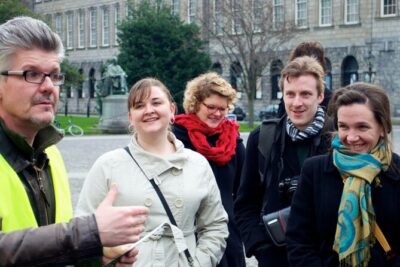

Historical 2-Hour Guided Walking Tour of Dublin
Read our review →
Dublin Traditional Irish 3 Course Meal Walking Tour with Local
Read our review →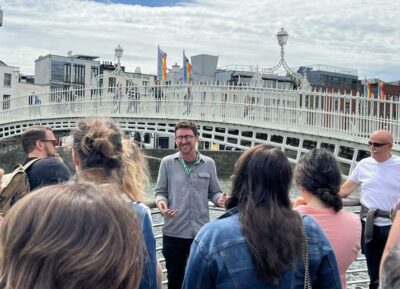
Browse the lists this tour appears in