
Reviewed · DUBLIN CITY WALKING TOURS
Dublin Highlights: 2.45-Hour Walking Tour in Italian
Dublin’s story comes into focus on foot, especially when your Italian-speaking guide links Molly Malone, British rule, the 1916 Rising, and modern pub life in one compact route. You move from Trinity College to the Spire, crossing the Liffey and seeing the city’s main sights without spending time on a bus.
I like the strong first-day orientation and the useful local advice about Irish stew, live music, and pubs. I also like that guides such as Melania and Michela V. bring a warm, lively style that can keep younger visitors involved, including an eight-year-old noted in the tour feedback.
The main drawback is simple: this is a sightseeing walk, not an inside tour of Dublin’s major buildings. Entrance fees are not included, and the pace, cobbled streets, and standing time make it a poor fit for wheelchair users or anyone who needs frequent rests.
Key points at a glance
- Italian from start to finish: The live guide explains Dublin’s past and present in Italian.
- A useful first-day route: Trinity College, Dublin Castle, both cathedrals, Temple Bar, the Ha’penny Bridge, the GPO, and the Spire fit into one central walk.
- History with recognizable characters: St. Patrick, Molly Malone, British rule, and the 1921 treaty all help turn streets into a readable story.
- Practical Dublin advice: You receive suggestions for Irish stew, live music, pubs, and places to eat after the walk.
- About $28 per person: The price is fair if you want context and orientation, but less attractive if you only want exterior photos.
- A walking-only experience: Wear comfortable shoes, carry weather protection, and leave large luggage behind.
Why this Italian tour works well on a first day
Dublin’s center is compact, but its history is not. A short walk can take you from medieval church sites to Georgian streets, from British administration to Irish independence, and from literary landmarks to the city’s modern nightlife. The useful part of this tour is the connection between those places.
You are not simply pointed toward a cathedral and told its name. The route begins with Ireland’s religious past, moves through the years of British control, reaches the political upheaval of the early 20th century, and finishes on O’Connell Street, where the Spire gives you a clear sense of the modern city.
I would schedule this near the start of your Dublin stay. The guide’s recommendations can help you decide where to eat and drink later, and the walk gives you a mental map before you set off on your own. The tour also works as a quick introduction for an Italian-speaking family that wants the basics without committing to a full-day excursion.
The group walks through public streets, so the experience depends on the guide’s storytelling more than on formal exhibits. That is a plus for many people, but you should not expect a museum tour or detailed access to the interiors of the attractions.
More Dublin walking tours:
- Dublin Highlights and Hidden Gems Guided Walking Tour
★ 5.0 · 6,020 reviews - Dublin: Highlights and Hidden Gems Walking Tour
★ 4.9 · 2,140 reviews - 1916 Rebellion Walking Tour
★ 5.0 · 1,605 reviews
Meeting at Trinity College and finding Molly Malone
The walk begins at the Henry Grattan Monument on College Green, in front of Trinity College. Look for the guide wearing a badge with the local supplier’s name. This is a central meeting point, but College Green can be busy, so arrive with enough time to identify the statue and guide before the group sets off.
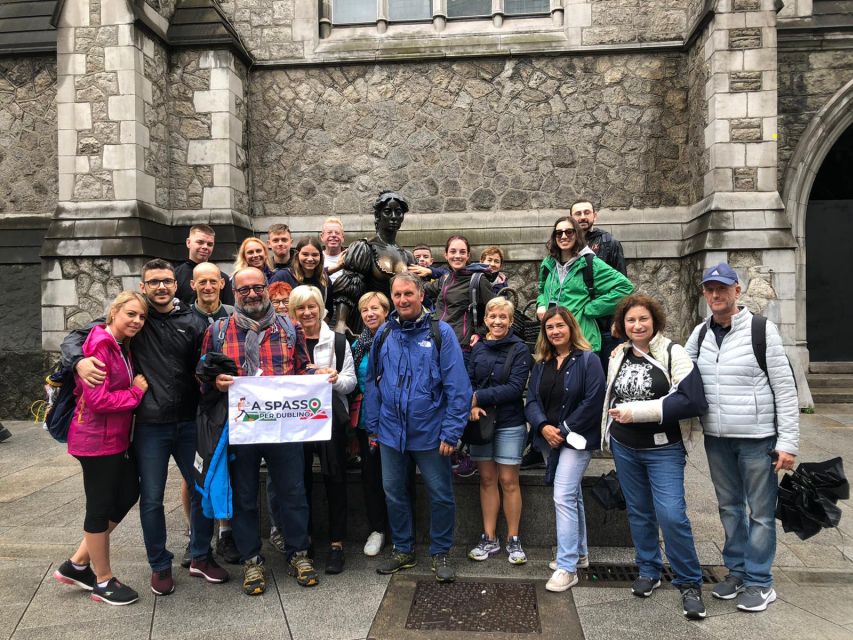
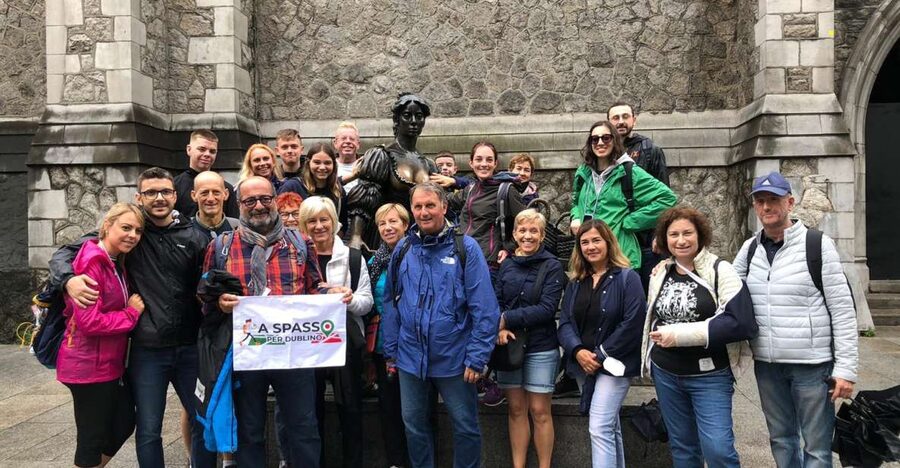
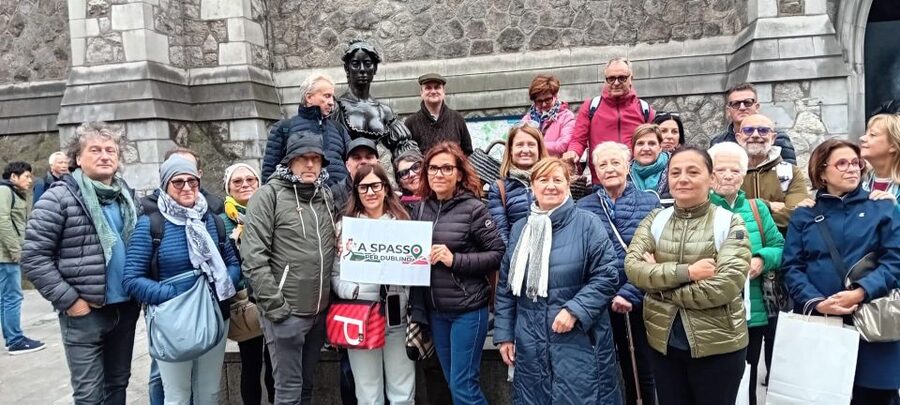
Trinity College provides a fitting opening. It places you in one of Dublin’s best-known historic areas right away, and it gives the guide a natural setting for explaining the city’s early development. From there, the route includes the Molly Malone Statue, one of Dublin’s most familiar photo stops.
Molly Malone is more than a quick statue stop here. Her legend gives the guide a chance to talk about how songs, folklore, and public monuments shape the way a city tells its own story. You will likely spend only a short time at the statue, but it is a useful early moment because it is easy to recognize and easy to revisit later.
Families may appreciate this part of the walk. A named character and a memorable legend can hold a child’s attention better than a long list of dates. One account of the tour specifically praised Melania for keeping an eight-year-old engaged throughout the walk, which suggests that her presentation can work well for mixed-age groups.
Dublin Castle and the years of British rule
Dublin Castle is one of the tour’s most important history stops. Its connection to British administration gives the guide a clear way to explain Ireland’s political past, including the period that ended with the signing of the Anglo-Irish Treaty in 1921.
The value here is the setting. You are standing at a place associated with power, government, and control, not just looking at a decorative old building. A good explanation can help you understand why Dublin’s political history still matters when you walk through the city today.
The tour focuses on the exterior and surrounding area rather than including admission. That keeps the price down and the route moving, but it also means you will not receive a full visit to the castle rooms or exhibitions. If Dublin Castle is a major priority for you, plan a separate paid visit and use this stop as an introduction.
At roughly $28 per person, this approach makes sense. You pay for the guide, the route, and the interpretation of the city rather than for a bundle of entrance tickets. That is good value if you want an overview and plan to choose your own interiors afterward.
St. Patrick’s Cathedral and Christ Church Cathedral
The route then reaches St. Patrick’s Cathedral and Christ Church Cathedral. Seeing both matters because they are not interchangeable stops. Each helps you read a different part of Dublin’s religious and architectural past.
St. Patrick’s Cathedral is closely tied to the story of St. Patrick and the arrival of Christianity in Ireland. The guide uses the early days of evangelization as part of the larger story, linking the city’s religious identity to the streets you are walking through.
Christ Church Cathedral adds another major landmark to the route. Together, the two cathedrals create a strong visual section of the tour, and their facades give you some of the walk’s best architectural moments. You can pause for photos and hear the background without losing sight of the wider city story.
Again, entrance fees are not included. That is worth noting before you book, since cathedral admission can change the total cost if you decide to go inside both. The guided walk still has value if you prefer to admire the exteriors, but travelers who want detailed interior visits should allow extra time and money.
The route may also feel full at this point. You are seeing several major sights in one session, so the guide must keep the group moving. I like the efficient coverage, but you should not expect long, quiet periods at each cathedral.
A completely different kind of day out of Dublin:
- Dublin to Cliffs of Moher, including Wild Atlantic Way and Galway
★ 5.0 · 23,331 reviews - From Dublin: Cliffs of Moher, Burren & Galway City Day Tour
★ 4.8 · 18,888 reviews - Dublin: Guinness Storehouse Entry Ticket
★ 4.6 · 16,863 reviews - Dublin to Cliffs of Moher, Burren, Wild Atlantic Way, Galway Tour
★ 5.0 · 12,924 reviews
Temple Bar beyond the nightlife image
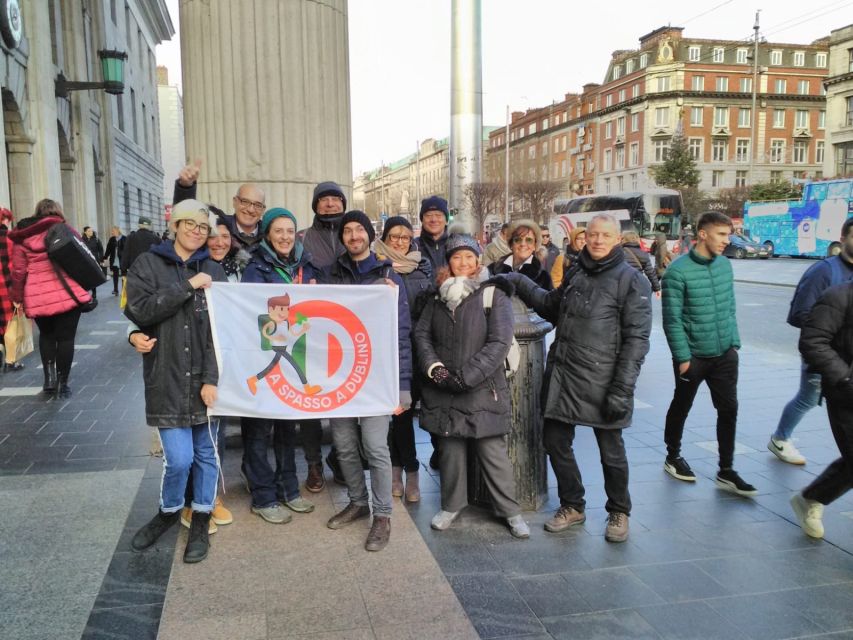
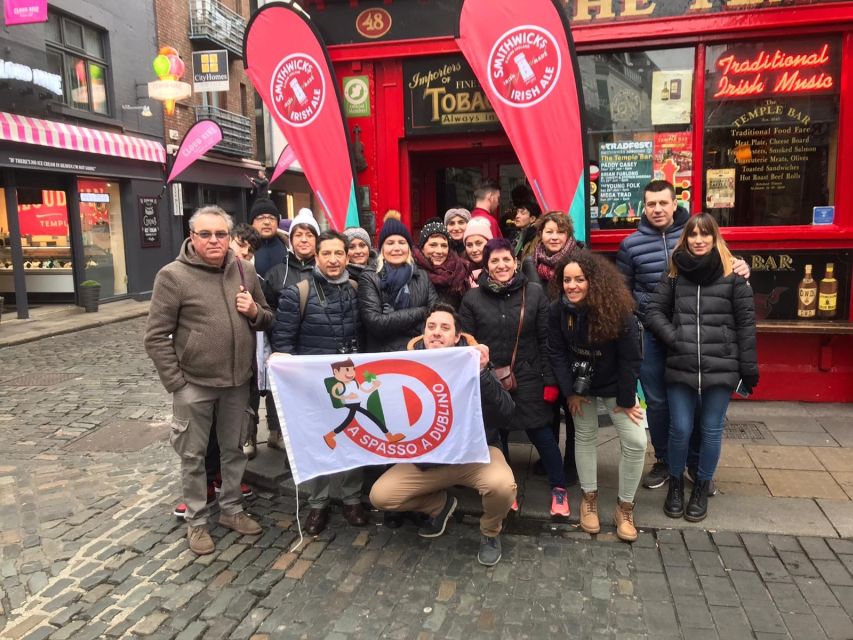
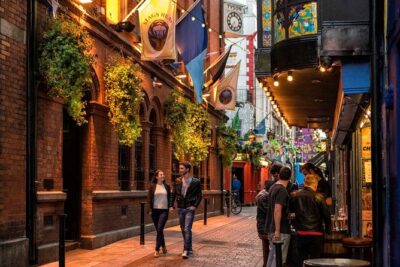
Temple Bar is Dublin’s best-known entertainment district, and it is an obvious stop on a city-center highlights walk. The area is associated with pubs, music, restaurants, and evening crowds, but it is also useful as a place to discuss how Dublin presents itself to visitors.
The guide can put the district in context rather than leaving you with a quick pub photo. You will receive practical suggestions about where to hear live music and where to find good food, including Irish stew. Those tips may be more useful than another general recommendation to visit a pub.
Temple Bar can be busy, especially at popular times, and the walk does not promise a reserved table, a music performance, or a meal. Think of this as an orientation stop. You learn how the area fits into the city, then decide later if you want to return.
The included discounts add some extra value after the walk. You receive 15 percent off at The Well Restaurant, Wallace Tavernam, and the Irish Whiskey Museum, plus 10 percent off at Sfuso and a special bundle at Caffè Cagliostro. Check the exact terms when you book or arrive, but these offers can help soften the tour cost if you already plan to eat or visit one of those places.
Crossing the Liffey on the Ha’penny Bridge
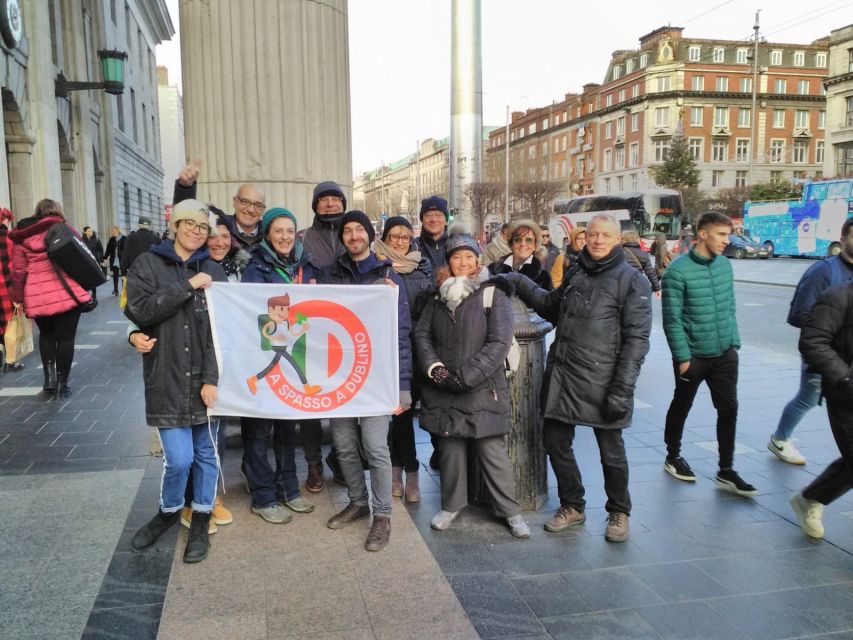
The Ha’penny Bridge is one of Dublin’s most recognizable crossings and an enjoyable change of scene in the middle of the walk. Crossing the Liffey gives you a clear sense of how the city is arranged around the river, and it creates a natural transition from the south side to the north side.
This is also one of the tour’s most photogenic moments. You can look back toward the central streets, watch the river traffic, and get a simple landmark photo without leaving the walking route.
The bridge can feel narrow when busy, so stay with the group and follow the guide’s instructions. It is not a long stop, but it gives the route a welcome change from streets and building facades.
The crossing also helps the tour feel like a city walk rather than a chain of isolated monuments. You are moving through Dublin’s public spaces and seeing how the river links different parts of the center.
The GPO and Ireland’s political turning point
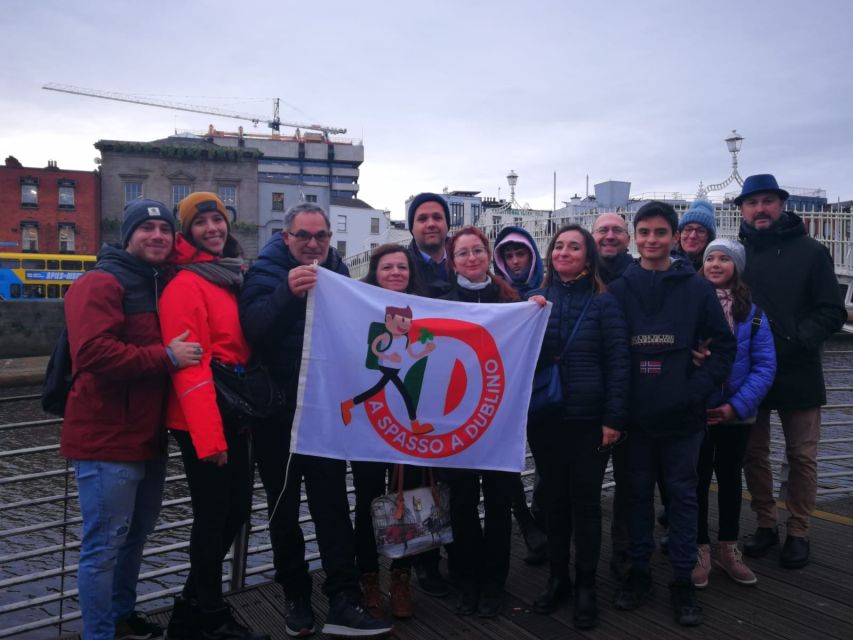
On the north side of the Liffey, the group reaches the General Post Office, often called the GPO. It is one of the last Georgian buildings built in Dublin and one of the city’s key political landmarks.
The GPO is especially useful because it connects the earlier discussion of British control and the 1921 treaty with the wider struggle for Irish independence. The guide can place the building within the political story instead of treating it as just another handsome facade.
The stop is listed as the GPO Museum, but entrance fees are not included. You should confirm what is covered on your chosen departure if you want to visit the museum itself. The walking tour provides the outside context, while a separate museum visit would require its own time and ticket.
This is one of the strongest history stops for adults who want more than a quick list of Dublin attractions. It also gives families a concrete place to connect political events with a real building. Children may not follow every detail, but the guide can make the setting more understandable through stories and landmarks.
Finishing at the Spire on O’Connell Street
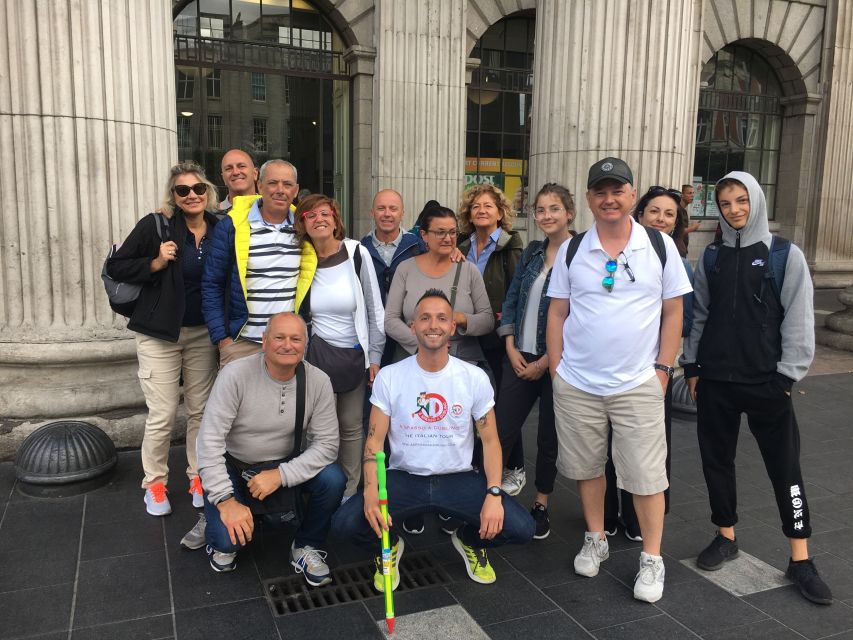
The published route ends at the Spire of Dublin on O’Connell Street. The monument is easy to spot and makes a practical end point because it places you on one of the city’s main north-side avenues.
From here, you can continue exploring on foot, use the guide’s food and pub suggestions, or pause to get your bearings. The tour is designed to leave you with enough information to plan the rest of your time, not to fill your entire day.
There is one logistical point worth checking before departure. The meeting information also describes the activity as ending back at the meeting point, while the route details name the Spire as the finish. Confirm the exact end location for your selected date so you know where to collect anyone who is not walking the full route.
What the $28 price really buys you
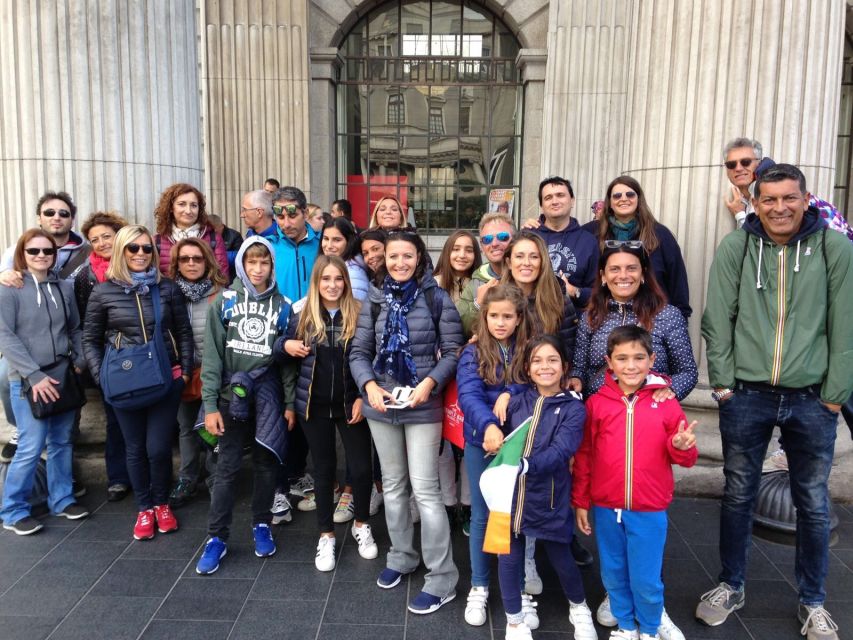
At $28 per person, this is a reasonable price for a three-hour guided walk through Dublin’s central sights. You are paying for an Italian-speaking guide, a planned route, historical explanations, and practical recommendations that can save you time later.
The value is strongest if you would otherwise spend the first day piecing these places together on your own. Dublin’s center is walkable, but signs and building facades do not always explain the connections between St. Patrick, British administration, the Anglo-Irish Treaty, the GPO, and present-day city life.
The value is weaker if you only want to photograph the major sights or if you plan to enter every attraction independently. Since admission is not included, the total cost can rise once you add cathedral, castle, or museum tickets.
The discounts may improve the deal for you. If you use one of the restaurant, pub, whiskey museum, or café offers, the tour can provide both orientation and a modest saving. Do not book solely for the discounts, though. The main product is the guided walk in Italian.
Timing, clothing, and practical limits
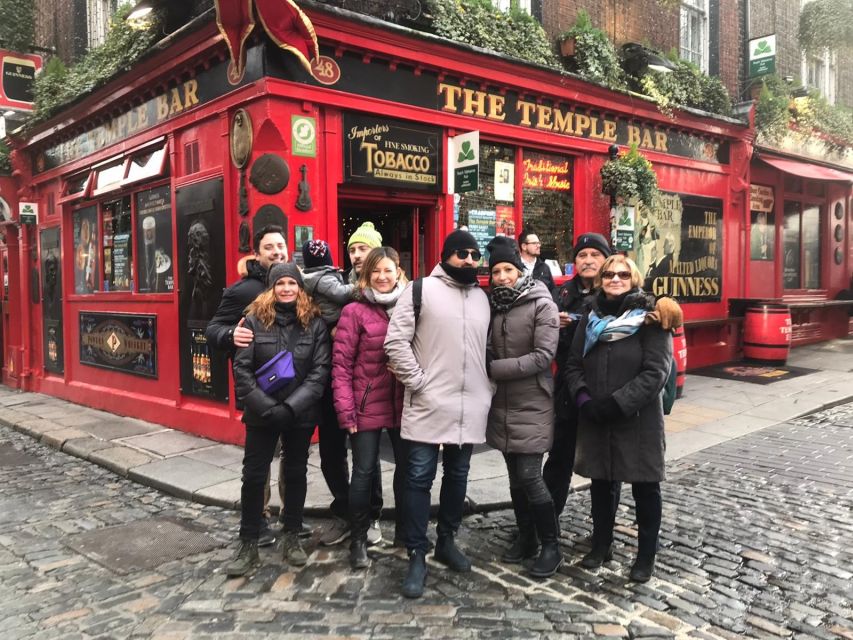
The experience lasts about three hours, with departure times shown when you check availability. Choose a start time that leaves room for a meal or another activity afterward, since the route covers many stops and includes steady walking.
Comfortable shoes are essential. Bring sunglasses, a sun hat, and an umbrella because Dublin weather can change quickly. Large bags and luggage are not allowed, so leave suitcases at your accommodation or make another arrangement before arriving.
The tour is not suitable for wheelchair users. The route includes city streets, bridge crossings, and extended walking, so anyone with limited mobility should ask the supplier for current route details before booking.
Free cancellation is available up to 24 hours in advance for a full refund. You can also reserve now and pay later, which is helpful if your Dublin schedule is still shifting.
The tour guide speaks Italian. That makes this a clear choice for Italian-speaking visitors who want history explained naturally rather than through an audio guide or translated leaflet. It may also suit bilingual families who want one shared language for the entire walk.
Who should book this Dublin walk
I would recommend it most to first-time visitors, Italian-speaking couples, families, and anyone who wants a clear introduction before exploring alone. The route covers the city’s essential center and adds useful advice about meals, pubs, music, and later day trips.
It is also a good choice if you want to book excursions beyond Dublin. At the end, you may receive information about trips to the Cliffs of Moher, the Giant’s Causeway, Howth, Galway, Connemara, Cork, Blarney Castle, Belfast, Newgrange, and other destinations. Treat that as optional sales information, not a required part of the walk.
I would skip it if you want a slow architectural study, extensive time inside each landmark, or a route designed for reduced mobility. You may also prefer a self-guided walk if you already know Dublin’s history and only need directions.
Should you book it?
Book this tour if you want an efficient Italian-language introduction to central Dublin, especially early in your stay. The combination of Trinity College, Molly Malone, Dublin Castle, both cathedrals, Temple Bar, the Ha’penny Bridge, the GPO, and the Spire gives you a strong first look at the city.
The best reason to choose it is the guide’s role. Melania and Michela V. are specifically associated with a friendly, engaging approach, and the feedback points to good family appeal. Just remember that this is an outdoor overview, entrance fees are extra, and the three-hour route requires comfortable walking.
FAQ
What language is the tour conducted in?
The live tour guide speaks Italian. The activity is designed for Italian-speaking visitors.
How long does the walking tour last?
The tour lasts about three hours. Check availability for the starting times offered on your chosen date.
Where does the tour start?
Meet at the Henry Grattan Monument in front of Trinity College on College Green. Look for a guide wearing a badge with the local supplier’s name.
Which Dublin sights are included on the route?
The route includes Trinity College, the Molly Malone Statue, Dublin Castle, St. Patrick’s Cathedral, Christ Church Cathedral, Temple Bar, the Ha’penny Bridge, the GPO, and the Spire of Dublin.
Are entrance fees included?
No. Entrance fees are not included, so you will need to pay separately if you choose to enter Dublin Castle, the cathedrals, the GPO Museum, or other attractions.
Is the tour suitable for wheelchair users?
No. The activity is listed as not suitable for wheelchair users.
What should I bring?
Wear comfortable shoes and consider bringing sunglasses, a sun hat, and an umbrella. Luggage and large bags are not allowed.
Can I cancel the booking?
Yes. You can cancel up to 24 hours in advance for a full refund. Reserve now and pay later is also available.
Just added around Dublin
- Wicklow: Private Day Tour from Dublin★ 5.0 · 5 reviews
- Wicklow Mountains Private Day Tour including Glendalough★ 5.0 · 7 reviews
- Wicklow Mountains & Glendalough Luxury Private Day Tour★ 5.0 · 23 reviews
- Wicklow tour of Glendalough★ 4.5 · 8 reviews
- Women Of Ireland: Trailblazers & Pioneers★ 5.0 · 4 reviews
- Dublin To Kilkenny Castle Waterford Crystal Private Car – Day Tour★ 5.0 · 8 reviews
- Waterford Crystal and Kilkenny Full-Day Rail Tour from Dublin★ 5.0 · 3 reviews
- Full Day Private Wicklow Tour★ 5.0 · 12 reviews
Dublin City Walking Tours, compared.
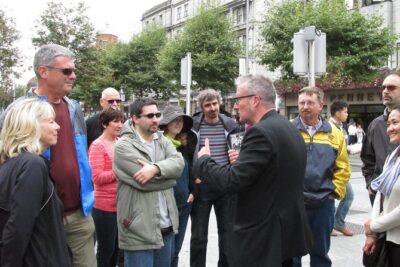
Dublin Highlights and Hidden Gems Guided Walking Tour
Read our review →
90 Minute Dublin Walking tour and Sightseeing tips
Read our review →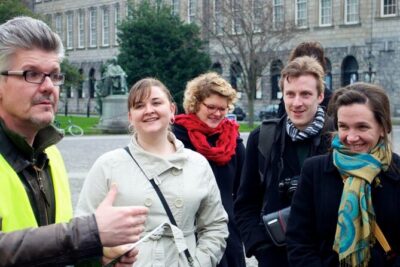

Historical 2-Hour Guided Walking Tour of Dublin
Read our review →
Dublin Traditional Irish 3 Course Meal Walking Tour with Local
Read our review →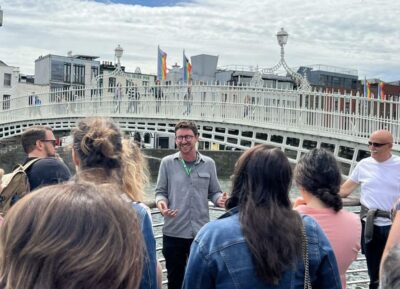
Browse the lists this tour appears in