
Reviewed · DUBLIN CITY WALKING TOURS
Dublin: Highlights and Hidden Corners Walking Tour
Dublin’s best introduction may be found in the odd details between its famous sights: a former Lisbon tram serving as a café, a church that is now a café and bar, a wobbly bridge, and a post box tied to Irish independence. This 2.5-hour walk connects those surprises with City Hall, Dublin Castle, the General Post Office, and Trinity College.
I like the small group limit of 16, which gives you a better chance to hear the guide and ask questions. I also like the guides’ human approach. Joe Brennan is praised for a steady pace and clear delivery, while Jacob, Katie, Dave, and John O’Flynn are all noted for warmth, humor, and strong local knowledge.
The main consideration is pace. One person found the walk faster than preferred, so allow for steady city walking on busy pavements. Also check the end point carefully: the route description finishes near Trinity College, while the meeting details say the activity ends back at the starting point.
Key points to know before booking
- See both sides of the River Liffey: The route links Dublin’s medieval quarter with Temple Bar, the Italian Quarter, and O’Connell Street.
- Expect more than landmark photos: Stories cover the 1916 Rising, Irish independence, old churches, former cinemas, trams, bridges, and city characters.
- Small groups matter: Numbers are limited to 16, and extra guides may be added when needed.
- The walk is led in English: A live professional guide leads the full experience.
- Most visits are external: You see the buildings and sites from outside, with suggestions for visiting some places later.
- Good first-day choice: The route gives you a useful map of central Dublin before you explore on your own.
A smart start in Dublin’s old center
Meet at the Tree of Gold statue, known in Irish as Crann an Óir, at Central Plaza on Dame Street. It is near the corner of Dame Street and Fownes Street Upper, placing you right in the center of Dublin’s old core.
That starting point is useful because the walk quickly moves into the former Viking and medieval quarter. You are not spending the opening stretch on a bus or waiting for transport. You begin on foot, with the city’s streets, façades, and small details close at hand.
A guide-led walk also helps you make sense of Dublin’s layout. The route crosses both sides of the River Liffey, but it begins south of the river and ends in the city center near Trinity College according to the route description. That makes it a handy orientation walk early in a stay.
The experience is conducted in English. The company limits the group to 16 people and may provide extra guides when demand requires it. That is a meaningful feature here, since several stops involve standing on public streets where a very large group would be difficult to manage.
More Dublin walking tours:
- Dublin Highlights and Hidden Gems Guided Walking Tour
★ 5.0 · 6,020 reviews - Dublin: Highlights and Hidden Gems Walking Tour
★ 4.9 · 2,140 reviews - 1916 Rebellion Walking Tour
★ 5.0 · 1,605 reviews
City Hall, Dublin Castle, and the medieval quarter
The first part of the walk takes you past City Hall and into the Dublin Castle area. Visits are external, so this is not a ticketed castle tour or an interior architectural inspection. Instead, your guide explains what you are seeing while placing the buildings within Dublin’s political and urban story.
The castle grounds and gardens give the route a change of mood. After the city traffic around Dame Street, you get a more open setting and a chance to look at the area without rushing from room to room. I find this kind of outside commentary useful because you can return later if a particular building catches your interest.
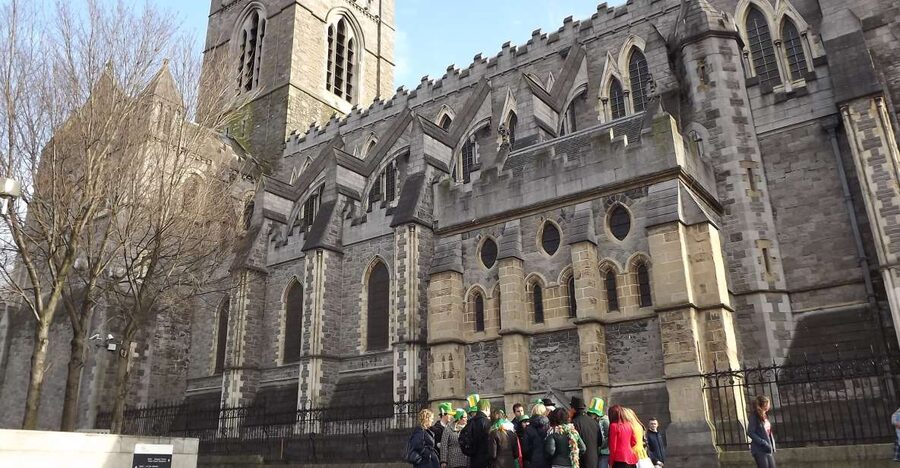
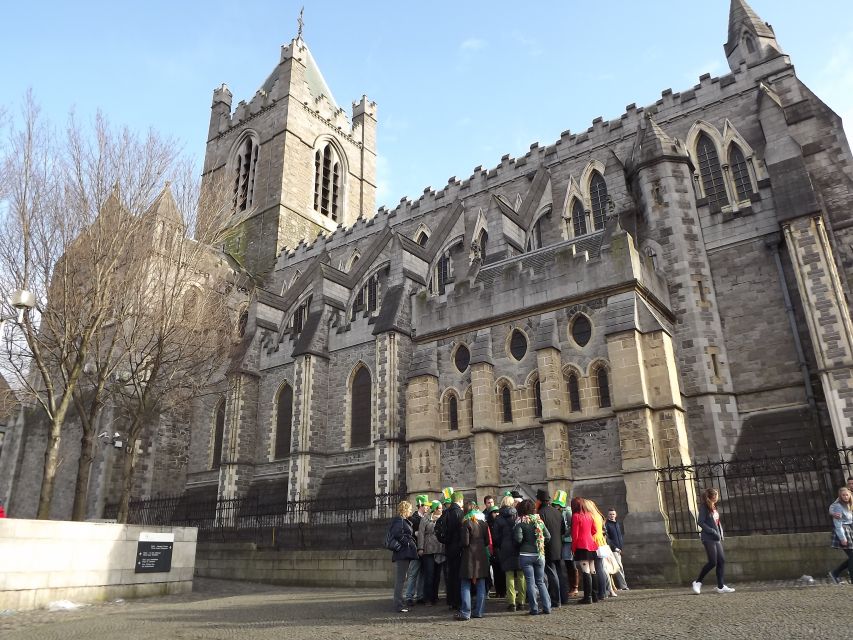
Christ Church Cathedral follows. The cathedral is one of the major landmarks in this part of Dublin, but the tour does not include entry. That keeps the walk moving and helps the guide cover more ground, though anyone wanting the full interior visit should plan a separate stop.
The value here is context. You are not seeing City Hall, Dublin Castle, and Christ Church as isolated attractions. The route places them close together and explains how Dublin’s older center developed around them.
Fishamble Street and the stories beneath the streets
Fishamble Street and Smock Alley bring the walk into a more intimate part of central Dublin. These streets are less about one grand monument and more about the stories attached to ordinary corners.
This is where the guide’s style matters most. A sign or façade may tell you little by itself, while a local guide can point out the building’s former role, a curious detail, or a connection to Dublin’s social life. The experience is designed around those short stories.
You may also hear about Dublin’s first full-time cinema, now defunct. That kind of stop will appeal to you if you enjoy the city’s lost places as much as its famous survivors. It shows how the tour moves beyond the standard postcard route without abandoning the major sights.
Because the walk is external, you should think of it as a narrated street tour rather than a sequence of museum visits. You see where things happened, learn why the places matter, and can return independently when you want more time.
Meeting House Square and Temple Bar without stopping at the obvious
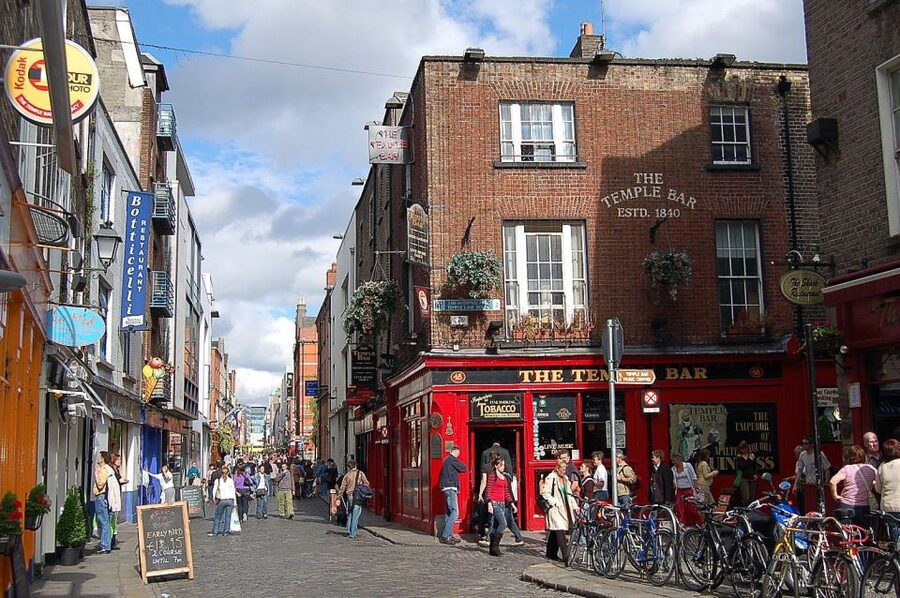
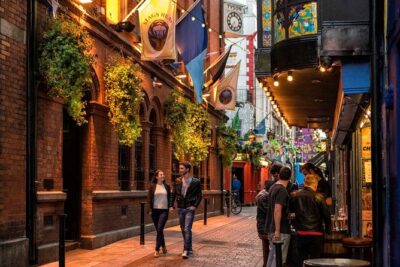
The route continues through Meeting House Square and Temple Bar. This is one of Dublin’s most visited areas, but the walk does not treat it as a simple nightlife district.
The guide points out details that are easy to miss when you are focused on pubs and crowds. Temple Bar becomes a setting for stories about buildings, public spaces, and the way Dublin’s center has changed over time.
You will want comfortable shoes here. Temple Bar and the surrounding streets can be busy, and the group needs to keep together while stopping for explanations. The tour’s limited size should make that easier, but it cannot remove the normal city traffic and crowded pavements.
I like this section because it gives you a more useful look at Temple Bar. Instead of only asking where to eat or drink, you begin to understand how the quarter fits into the city around it. Your guide may also offer suggestions for the rest of your visit, which is useful if this is your first afternoon in Dublin.
A completely different kind of day out of Dublin:
- Dublin to Cliffs of Moher, including Wild Atlantic Way and Galway
★ 5.0 · 23,331 reviews - From Dublin: Cliffs of Moher, Burren & Galway City Day Tour
★ 4.8 · 18,888 reviews - Dublin: Guinness Storehouse Entry Ticket
★ 4.6 · 16,863 reviews - Dublin to Cliffs of Moher, Burren, Wild Atlantic Way, Galway Tour
★ 5.0 · 12,924 reviews
Across the Millennium Bridge to the north side
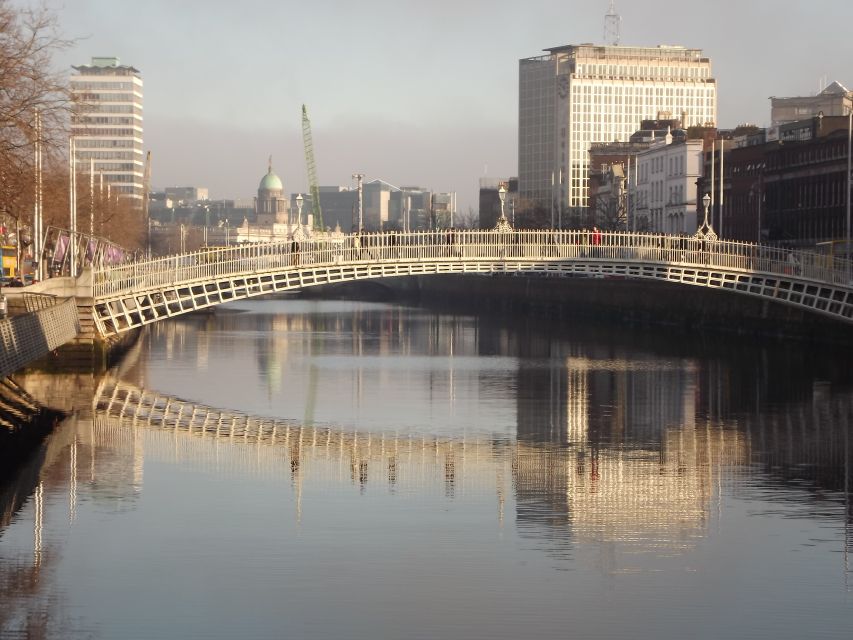
The Millennium Bridge carries the group across the River Liffey. The river crossing is more than a change of scenery. It gives you a simple visual sense of how Dublin’s central districts connect.
The tour also includes the Italian Quarter, a compact area with its own restaurants, cafés, and city character. Again, this is the sort of place that can pass unnoticed when you are hurrying between major attractions. Your guide helps you see the north side as part of the same central city rather than as an afterthought.
One amusing feature on the route is a former Lisbon tram now used as a café. It is an excellent example of the tour’s approach: you get a landmark, but you also get a piece of urban oddness that you probably would not seek out alone.
The bridge itself is another playful stop. The guide may invite you to feel its bounce. It is a small moment, but these physical details help break up the historical explanations and keep the walk lively.
St Mary’s Church and Dublin’s unusual conversions
St Mary’s Church is now a well-known café and bar. The building’s current use makes it a memorable stop because you can compare its religious past with its modern role without needing a long detour.
The tour also points out an unusual representation of a painting by Leonardo da Vinci. The supplied route description does not specify the exact work, so you should expect a curious art-related detail rather than a formal art lecture.
These stops work well for a first look at Dublin because they show how the city reuses old structures. You see that Dublin’s past is not confined to preserved monuments. It also survives in places that have changed purpose while keeping visible traces of what came before.
Do not expect extended time inside each place. The tour is designed to cover a broad slice of central Dublin, and the guide has to keep the group moving toward the north side. If a café or church interests you, note it down for a later visit.
Henry Street, Moore Street, and the everyday city
Henry Street and Moore Street bring the tour into a more everyday part of central Dublin. These are useful streets to include because they connect the official landmarks with shopping, markets, local movement, and ordinary city life.
The guide may also point out a stark, unclothed representation of a famous 18th-century composer. It is the sort of unexpected visual joke that gives the walk its character. You will probably remember the odd detail long after you have forgotten another formal date.
This portion helps prevent the experience from becoming a parade of government buildings and cathedrals. You see Dublin as a lived-in city, with commercial streets and public spaces alongside its monuments.
The trade-off is that this is a walking tour through active city streets, not a quiet country stroll. You may need to pause close to the group and pay attention to traffic, pedestrians, and the guide’s position.
O’Connell Street and the General Post Office
O’Connell Street is one of the major historic avenues on the route. The General Post Office is the key stop here. It served as the headquarters of the rebels during the 1916 Rising, and the fighting led to the destruction of the building and much of the surrounding street.
This is one of the tour’s most important historical moments. The guide connects a familiar public building with the events that helped shape modern Ireland. You are not just looking at a post office. You are looking at a place tied to rebellion, destruction, and the country’s move toward independence.
The route also includes the O’Connell Monument. Together, the monument and the General Post Office make O’Connell Street a strong setting for political and civic stories.
A particularly good small detail is the Irish post box that represents the change from British rule to independence. It is easy to walk past a painted or altered post box without noticing what it signals. A guide can turn that everyday object into a compact lesson in Irish political change.
The street is wide and busy, so this may be one of the less relaxed sections. Still, the open space makes it easier to understand the scale of the area and the effect of the 1916 Rising on the city around it.
Former Parliament House and the approach to Trinity
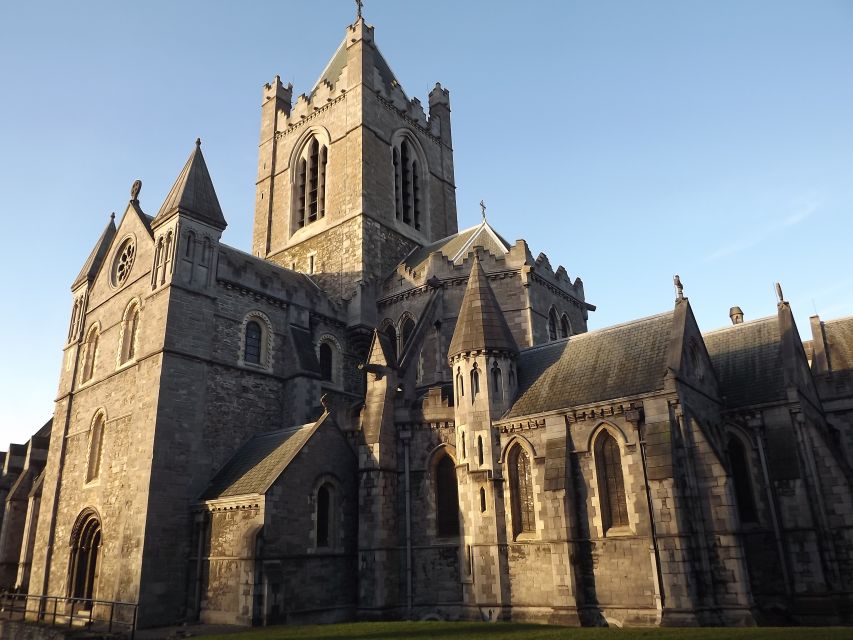
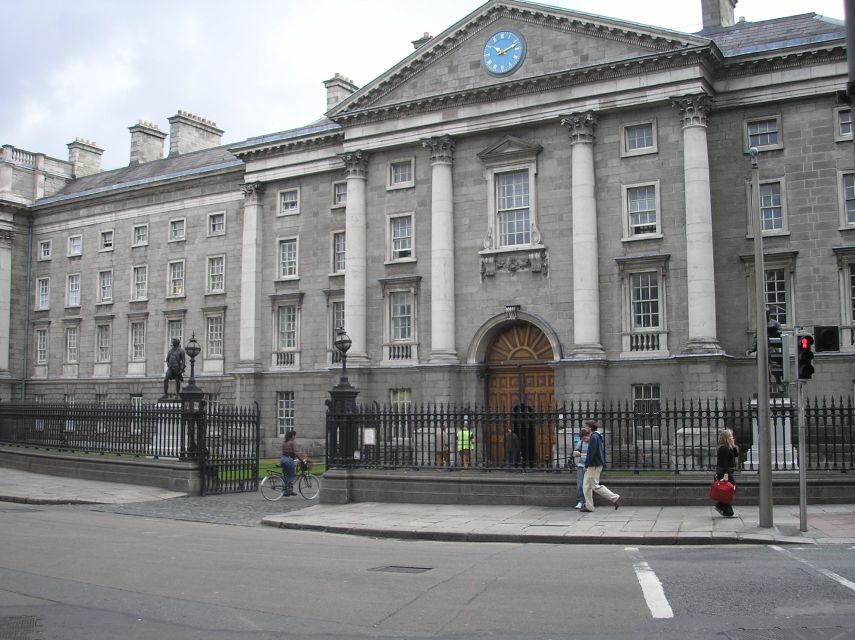
The final major stretch leads back toward College Green and the former 18th-century Houses of Parliament, now the Bank of Ireland. The building’s changing role gives the guide another chance to explain how Dublin’s political institutions developed.
The walk finishes outside Trinity College, near the famed Book of Kells. This is an effective endpoint because Trinity is one of Dublin’s most recognizable institutions and a useful place to continue exploring on your own.
The Book of Kells itself is not included in the walk. The advertised experience is external, with opportunities to visit sites afterward. If you want to see the manuscript and the Old Library, you will need to arrange that separately.
The route information contains a practical inconsistency. The detailed walk ends around Trinity College, while the meeting-point section says the activity ends back at the starting point. Confirm the final location when booking, especially if you have a timed Trinity visit, restaurant reservation, or onward transport.
How the guides shape the experience
A good city walk depends heavily on the person leading it. The named guides associated with this experience include Joe Brennan, John O’Flynn, Jacob, Katie, and Dave.
Joe Brennan is described as having an especially comfortable delivery and walking pace. That matters because the tour covers a lot of ground in 2.5 hours. Jacob is noted for answering questions patiently and helping with directions after the walk. Katie is praised for combining solid information with humor and useful suggestions for the rest of a Dublin stay.
John O’Flynn is associated with clear explanations of Dublin’s architectural and political past. Dave is described as friendly, funny, and attentive to the group’s enjoyment. You may not receive the same guide on every departure, but the company’s strongest feature appears to be the guide-led storytelling rather than a fixed script alone.
The repeated praise for humor and a steady pace is worth taking seriously. Dublin has plenty of dates, names, and political events that can become heavy in a lecture. A friendly guide keeps the material approachable.
Price, duration, and who gets the best value
At $31 per person, the tour is fairly priced for a 2.5-hour small-group orientation, especially if you use it as the first structured activity of your Dublin visit. You are paying for a professional English-speaking guide, local explanation, and a route that links major sights with details you might otherwise miss.
The value is strongest if you want an overview before deciding which places deserve an interior visit. You can mark City Hall, Christ Church Cathedral, Dublin Castle, the General Post Office, Trinity College, and other stops for later.
It is less suitable if you want long visits inside buildings or a slow photography walk. Most stops are external, and the route keeps a purposeful pace. One person found it faster than ideal, so anyone with mobility concerns or a preference for unhurried walking should ask about the pace before booking.
The tour is wheelchair accessible, according to the activity information. Still, Dublin’s central pavements and public streets can be busy, so you may want to confirm any route-specific needs in advance.
Free cancellation is available up to 24 hours before the tour, and you can reserve now and pay later. Those terms are useful if your Dublin schedule may change.
Should you book this Dublin walking tour?
Book it if you want a well-rounded first look at central Dublin with a small group and a guide who explains the human stories behind the buildings. It suits first-time visitors, history fans, curious walkers, and anyone who wants practical suggestions for the rest of a stay.
Skip it if your priority is entering every major attraction, moving at a very slow pace, or spending most of the time inside museums and churches. For most people, though, the mix of Dublin Castle, Temple Bar, the Liffey, O’Connell Street, and Trinity College gives you a useful city framework in one morning or afternoon.
I would book it early in a Dublin visit, then use the route as a personal to-do list. Return to Christ Church Cathedral, the Book of Kells, or another stop that catches your eye, this time with enough time to explore inside.
FAQ
Where does the tour start?
It starts at the Tree of Gold statue, or Crann an Óir, in Central Plaza on Dame Street, Dublin 2, near the corner of Dame Street and Fownes Street Upper.
How long does the walking tour last?
The tour lasts 2.5 hours. Starting times vary, so check availability for the date you want.
What language is the tour conducted in?
The live tour is conducted in English.
What landmarks are included?
The route includes City Hall, Dublin Castle grounds and gardens, Christ Church Cathedral, Fishamble Street, Smock Alley, Meeting House Square, Temple Bar, the Millennium Bridge, the River Liffey, the Italian Quarter, St Mary’s Church, Henry Street, Moore Street, O’Connell Street, the General Post Office, the O’Connell Monument, the former Parliament House, and Trinity College.
Can I go inside the attractions during the tour?
Visits are external. Opportunities are available to visit some places after the walking tour.
Does the tour include the Book of Kells?
The tour finishes outside Trinity College, where the Book of Kells is located. Entry to see the Book of Kells is not included.
How large is the group?
The maximum group size is 16 people. Additional guides may be provided when required.
Is the tour wheelchair accessible?
Yes, the activity information lists the tour as wheelchair accessible.
Can I cancel or pay later?
You can cancel up to 24 hours in advance for a full refund. You can also reserve your place and pay later.
Just added around Dublin
- Wicklow: Private Day Tour from Dublin★ 5.0 · 5 reviews
- Wicklow Mountains Private Day Tour including Glendalough★ 5.0 · 7 reviews
- Wicklow tour of Glendalough★ 4.5 · 8 reviews
- Women Of Ireland: Trailblazers & Pioneers★ 5.0 · 4 reviews
- Wicklow Mountains & Glendalough Luxury Private Day Tour★ 5.0 · 23 reviews
- Dublin To Kilkenny Castle Waterford Crystal Private Car – Day Tour★ 5.0 · 8 reviews
- Waterford Crystal and Kilkenny Full-Day Rail Tour from Dublin★ 5.0 · 3 reviews
- Full Day Private Wicklow Tour★ 5.0 · 12 reviews
Dublin City Walking Tours, compared.
Dublin Highlights and Hidden Gems Guided Walking Tour
Read our review →
90 Minute Dublin Walking tour and Sightseeing tips
Read our review →

Historical 2-Hour Guided Walking Tour of Dublin
Read our review →
Dublin Traditional Irish 3 Course Meal Walking Tour with Local
Read our review →
Browse the lists this tour appears in