
Reviewed · TRADITIONAL IRISH MUSIC AND DANCE SHOWS
Dublin Traditional Irish Music Walking Tour with Live Performance
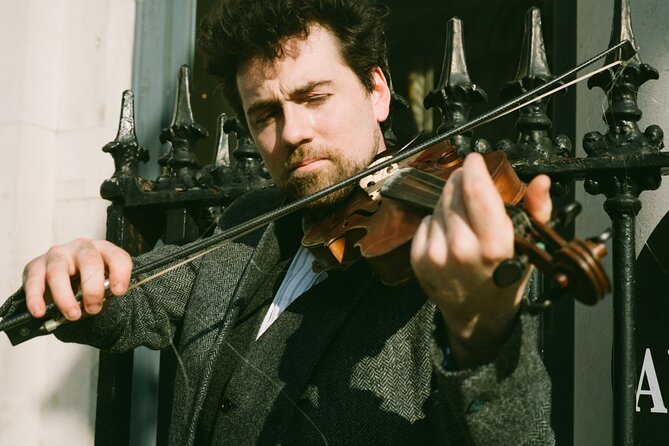
Dublin’s past comes alive here through songs rather than a standard lecture. Your musician-guide may be Ciaran, Sean, or Dylan, and each brings a guitar, mandolin, or voice to stories about theatres, Viking Dublin, politics, folklore, and cathedral life. I like the short walks between landmarks and the way each song connects to the place in front of you. I also like that the tour ends at St Patrick’s Cathedral, leaving you well placed for more sightseeing.
The main drawback is that this is a street performance, so sound can vary. One small group was accidentally mixed up with another walking tour, and street noise made it hard to hear. Meet carefully at 3 Crown Alley in Temple Bar, confirm you are with the music group, and stay close to the guide.
Key points to know before booking
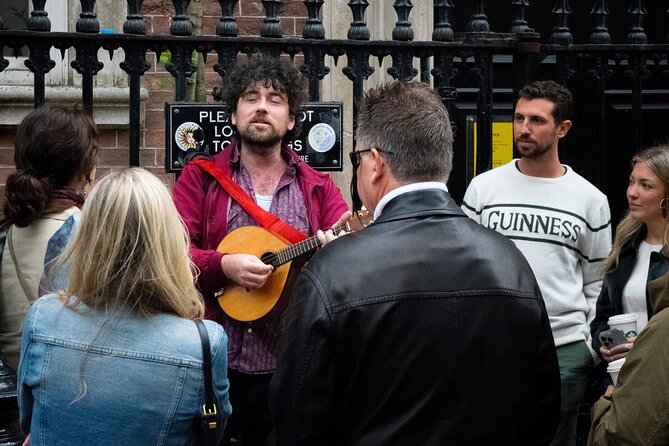
- Irish music carries the story: Songs, poems, and occasional dancing explain Dublin’s social and political past.
- The route covers central Dublin: You walk from Temple Bar across the Liffey and onward to Christ Church, Dublin Castle, and St Patrick’s Cathedral.
- Short walks keep the pace easy: The tour lasts about two hours, with roughly ten minutes at each listed stop.
- Small groups are the norm: Capacity is limited to 20 people, though clear hearing still depends on where you stand.
- The ending is useful: You finish at St Patrick’s Cathedral and can continue sightseeing from there.
- The price is fair for a live guide: At $27.81, you get a guided city walk plus a personal performance rather than a simple landmark tour.
Dublin history told with a guitar and a good sense of fun
Most Dublin walking tours ask you to look at buildings while a guide explains what happened there. This one asks you to listen. A traditional ballad may explain a neighborhood, a poem may open a door into Irish theatre, and a song in Gaelic may connect you with a part of Irish culture that a quick sightseeing walk could easily miss.
That format gives the tour its appeal. The guide is not simply pointing out Christ Church Cathedral or Dublin Castle. He is using the location as a stage and the music as a way to show how ordinary people remembered events, places, and characters.
The guides named in the feedback include Ciaran, Sean, and Dylan. Ciaran is praised for humor, poems, history, and an eclectic mix of Irish music. Sean is described as an engaging singer and instrumentalist who also gives useful suggestions for pubs and restaurants. Dylan links each song to the story of the place, including at least one song in Gaelic.
The exact performance depends on who leads your group. That is part of the charm, but it also means you should not expect a fixed concert set. You are booking a musical walking tour, not a formal theatre show.
More traditional Irish music and dance shows:
- Dublin: Kilkenny, Wicklow & Glendalough Tour & Sheepdog Show
★ 4.8 · 2,599 reviews - Dublin: Glendalough, Wicklow, Kilkenny and Sheepdog demonstration
★ 5.0 · 2,215 reviews - Dublin Irish House Party Live Show, Dinner Option Available
★ 4.5 · 1,246 reviews
Starting at 3 Crown Alley in Temple Bar
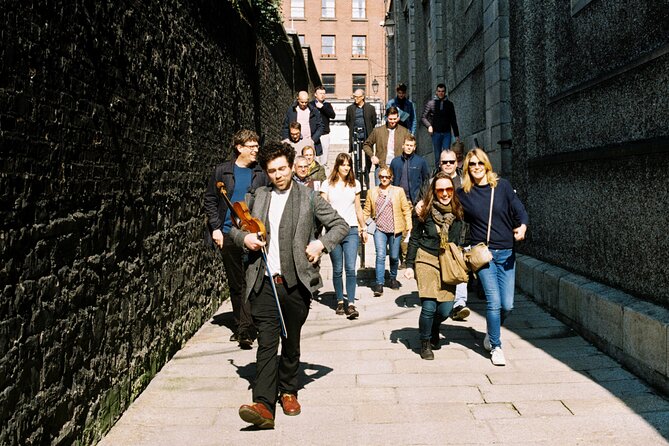
The meeting point is at 3 Crown Alley in Temple Bar, in the center of Dublin. The tour starts at 1:00 pm, and this is a busy area with several tours operating nearby, so do not wait passively for someone to gather you. Look for the music group and confirm the tour name with the guide.
This small check matters. One person ended up with a regular historical walking tour because two groups met in the same area and the split was not clear. That group still received a city history walk, but missed the music they had paid for. Arrive early enough to get oriented, and make sure your guide has an instrument or clearly identifies the traditional music tour.
Temple Bar is a practical starting point because it puts you close to the River Liffey, Christ Church Cathedral, Dublin Castle, and St Patrick’s Cathedral. It is also lively and noisy. If hearing is important to you, stay near the guide when the group stops and ask politely if a song or explanation is difficult to hear.
Smock Alley Theatre and Dublin’s performance tradition
The first named stop is Smock Alley Theatre 1662, described as Ireland’s oldest theatre. It sits in the heart of Temple Bar and gives the tour an early focus on performance, not just architecture.
You spend about ten minutes here. That is enough time for a concise explanation and a song, but not for a full theatre visit. The value is the connection between Dublin’s stage tradition and the musician-guide leading you through the city. A singing guide makes more sense here than at an ordinary street corner.
The theatre stop also sets your expectations. You will not spend long inside each landmark. This is a route of brief encounters, with music and storytelling filling the gaps between them.
Crossing the Liffey at Grattan Bridge
Grattan Bridge is one of the prettiest crossings on this route. Seahorse lanterns decorate the bridge, and it links Capel Street with Parliament Street. From here, you get a simple but useful sense of how the River Liffey divides and joins central Dublin.
The group pauses for about ten minutes. The bridge is a good place for photographs, but it can also be noisy and exposed. Keep your camera ready for the bridge details, then give your attention to the song or story rather than trying to do both at once.
I like this stop because it breaks up the older church and castle material with a view of the river and the city around it. The tour is not only about famous interiors. It uses streets, bridges, gates, and small details as prompts for music.
More Dublin walking tours:
- Dublin Highlights and Hidden Gems Guided Walking Tour
★ 5.0 · 6,020 reviews - Dublin: Highlights and Hidden Gems Walking Tour
★ 4.9 · 2,140 reviews - 1916 Rebellion Walking Tour
★ 5.0 · 1,605 reviews - 90 Minute Dublin Walking tour and Sightseeing tips
★ 5.0 · 916 reviews
Fishamble Street and the sound of old Dublin
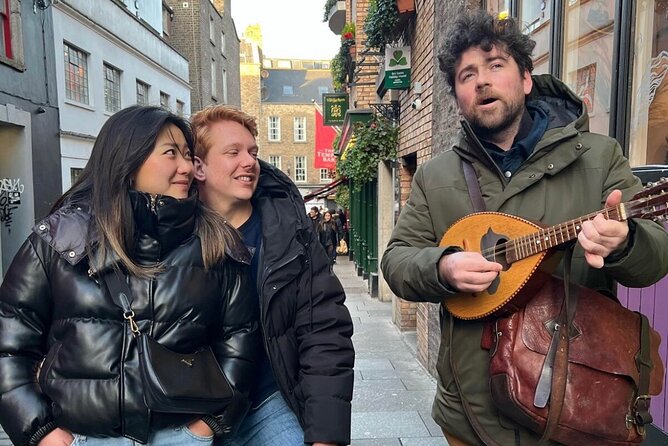
Fishamble Street is often described as Dublin’s oldest street. It was once linked with the largest Viking settlement found outside Scandinavia, and it is also associated with the first performance of Handel’s Messiah.
That combination gives the guide plenty to work with. You move from Viking settlement stories to Dublin’s later musical life, all on one street. A song here can show how music moved through religious spaces, public performances, and everyday city life.
The stop lasts about ten minutes, with admission listed as free. Do not expect a museum visit or an archaeological tour. The point is to hear the story in the setting where it belongs, then continue walking.
This is one of the tour’s strongest ideas: Dublin’s past is not presented as a list of dates. The guide ties a location to a lyric, melody, or performance tradition. If you enjoy Irish music already, you will likely appreciate the added context. If you know little about it, the explanations help you follow along.
Christ Church Cathedral and Dublin’s darker stories
Christ Church Cathedral marks the heart of medieval Dublin. Its medieval and Victorian elements give you a visual contrast, while the guide turns toward the cathedral’s more unusual and darker stories.
You explore some of the cathedral and nearby surroundings through song. The supplied details do not promise a full interior tour or admission to every part of the building, so treat this as a short guided look rather than a substitute for a dedicated cathedral visit.
That distinction is useful when planning your day. If you want to inspect the cathedral at length, reserve separate time for it. On this tour, the building serves as the setting for stories, music, and a glimpse into the less polished side of Dublin’s past.
The cathedral stop is also where the tour’s tone may become more theatrical. The guide can use a ballad or poem to bring out tragedy, folklore, or grim local tales. You might be invited to join in, but the tour is not presented as a compulsory singing class.
Dublin Castle and the Ship Street gate
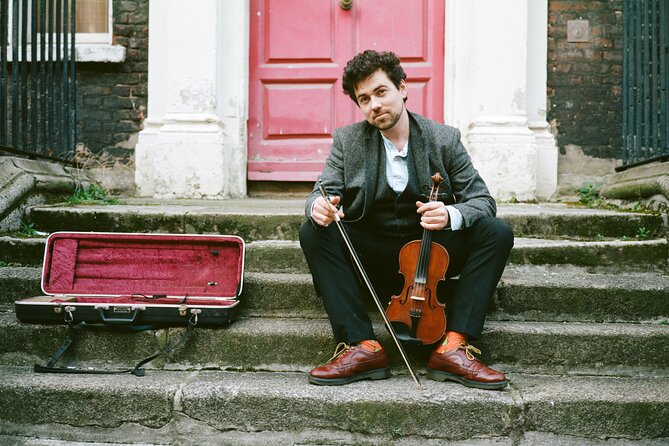
The walk continues to Dublin Castle, stopping at the Ship Street gate and some of the city’s most famous steps. This is another short outdoor stop, listed at about ten minutes.
The castle area helps explain Dublin’s political past, but the tour keeps moving. You will hear a focused story and a related song rather than receive a full castle tour. If you have already visited the castle, this musical angle can add something new. If you have not, note that the walk does not replace time inside the complex.
The steps and gate also make good photo points. Keep in mind that a group of up to 20 people can gather quickly on a narrow street. Move in close when the guide begins speaking, and take photographs during pauses so you do not miss the performance.
The best guides use this part of the route to show how songs can carry social and political meaning. That was one of the most praised features of the experience. Music here is not decoration. It helps explain how Dubliners expressed loyalty, protest, loss, humor, and local pride.
Finishing in St Patrick’s Park
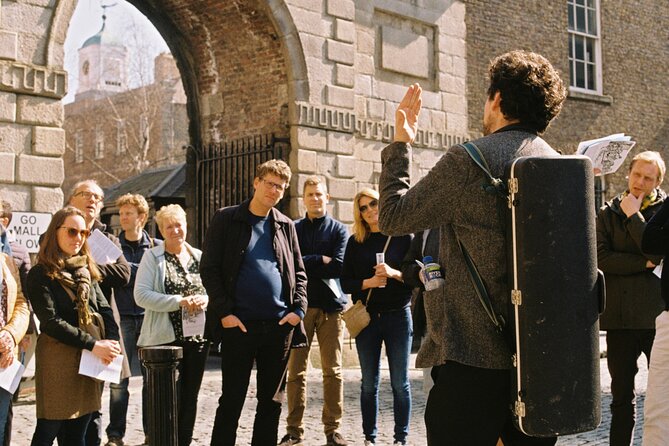
The tour finishes in St Patrick’s Park, beside St Patrick’s Cathedral. This is a pleasant end point because you are no longer being hurried toward another meeting place in the center of town. You can look around the park, visit the cathedral separately, or continue on foot through central Dublin.
The final stop gives the tour a clear shape. You begin amid Temple Bar’s theatre and music culture, cross the river, pass through medieval and political Dublin, and finish beside one of the city’s best-known religious landmarks.
Some guides use the ending for a final song, poem, or interactive moment. Dancing and sing-alongs are possible, but you do not need to arrive as a performer. The tone is friendly and playful, and even reserved members of a group may find themselves joining in once the guide establishes the mood.
What the $27.81 price really covers
At $27.81 per person, this is a reasonable price for a two-hour experience that combines sightseeing with live music. A standard walking tour gives you a guide and a route. This one adds a personal performance at several points, plus the unusual connection between lyrics and landmarks.
The value depends on what you want from Dublin. If you only need directions and a fast list of facts, a free walk may suit you better. If you want a pub concert, this is not that either. You are outside, moving through the city, and listening in changing street conditions.
For me, the price makes sense because the guide provides two jobs at once: city storyteller and musician. The music makes the route memorable, while the historical explanations give the songs a reason to be there.
The tour is generally booked about 32 days ahead, which suggests that planning early is sensible, especially if your Dublin dates are fixed. You receive a mobile ticket, and the group limit is 20 people. The published rating is 4.9 from 253 ratings, with 98 percent recommending it, but the hearing and meeting-point cautions still matter.
Who will enjoy this Dublin walk most
I would choose this tour for someone who wants a first look at central Dublin with more personality than a standard landmark circuit. It suits couples, families with older children, solo visitors, and anyone who likes folk music, storytelling, poetry, or Irish cultural history.
It is especially useful early in a Dublin visit. The route shows you where Temple Bar, the Liffey, Christ Church, Dublin Castle, and St Patrick’s Cathedral sit in relation to one another. The guide may also offer suggestions for pubs and restaurants after the walk.
Music fans should book with confidence, but you do not need to know Irish songs in advance. The guide explains what you are hearing and why it fits the location.
I would think twice if you need a quiet, highly structured tour or want extensive time inside the cathedrals and castle. Street noise, a group of up to 20 people, and short stops are part of the format. You may also prefer another activity if you strongly dislike audience participation, though the available feedback suggests the singing and dancing are handled with a light touch.
Wear comfortable shoes and allow for Dublin weather. The route is only about two hours, but it is still a walking activity across central streets and public spaces. Service animals are allowed, most people can participate, and the tour is near public transport.
Booking, cancellation, and timing tips
You can cancel for a full refund up to 24 hours before the 1:00 pm start time. Within 24 hours, the payment is not refunded, and changes are not accepted.
Your confirmation arrives when you book. The start and finish are in different places, so plan around that. Begin at 3 Crown Alley in Temple Bar and finish at St Patrick’s Close beside St Patrick’s Cathedral.
I would not schedule a major timed attraction immediately before the tour. Give yourself enough time to find the meeting point and identify the correct group. At the end, you are already near St Patrick’s Cathedral, but the activity itself does not promise a full cathedral admission.
Should you book the traditional Irish music walking tour?
Book it if you want Dublin explained through live music, local stories, and short walks between major sights. The strongest guides, including Ciaran, Sean, and Dylan, combine humor, history, poetry, and songs in a way that makes the city easier to remember.
Skip it if you want a quiet architectural tour, a full indoor visit to every landmark, or a polished concert setting. The best experience comes when you accept the street noise, stay close to the guide, and take part when invited.
For $27.81, this is a good-value introduction to Dublin, especially for a first visit. Just confirm the music group at Temple Bar, arrive ready to listen, and let the city tell its story in song.
FAQ
How long does the Dublin traditional Irish music walking tour last?
The tour lasts about two hours.
Where does the tour begin?
It begins at 3 Crown Alley in Temple Bar, Dublin, at 1:00 pm.
Where does the tour finish?
The tour finishes at St Patrick’s Cathedral, St Patrick’s Close, Dublin.
What sights are included on the route?
The route includes Smock Alley Theatre 1662, Grattan Bridge, Fishamble Street, Christ Church Cathedral, Dublin Castle’s Ship Street gate, and St Patrick’s Park beside St Patrick’s Cathedral.
How many people can join the tour?
The activity has a maximum group size of 20 people.
What is the cancellation policy?
You can cancel at least 24 hours before the start time for a full refund. Cancellations or changes made within 24 hours are not accepted, and the amount paid is not refunded.
Just added around Dublin
- Wicklow Mountains Private Day Tour including Glendalough★ 5.0 · 7 reviews
- Wicklow: Private Day Tour from Dublin★ 5.0 · 5 reviews
- Wicklow Mountains & Glendalough Luxury Private Day Tour★ 5.0 · 23 reviews
- Wicklow tour of Glendalough★ 4.5 · 8 reviews
- Women Of Ireland: Trailblazers & Pioneers★ 5.0 · 4 reviews
- Dublin To Kilkenny Castle Waterford Crystal Private Car – Day Tour★ 5.0 · 8 reviews
- Waterford Crystal and Kilkenny Full-Day Rail Tour from Dublin★ 5.0 · 3 reviews
- Full Day Private Wicklow Tour★ 5.0 · 12 reviews
Traditional Irish Music and Dance Shows, compared.

Kilkenny, Wicklow & Glendalough Tour & Sheepdog Show
Read our review →
Glendalough, Wicklow, Kilkenny and Sheepdog demonstration
Read our review →
Dublin Irish House Party Live Show, Dinner Option Available
Read our review →
Belvedere Irish Night Show, Dance and Traditional 3-Course Dinner
Read our review →

Dublin Traditional Irish 3 Course Meal Walking Tour with Local
Read our review →

Browse the lists this tour appears in