
Reviewed · HOWTH AND THE DUBLIN COAST TOURS
A Self-Guided Stroll Along Dún Laoghaire’s East Pier
Dún Laoghaire’s East Pier is more than a pleasant seaside walk. It is a compact lesson in Ireland’s port history, with an old railway path, ship memorials, a Russian cannon, and wide views across Dublin Bay. The audio route lets you take it at your own pace, without waiting for a group.
I like the low price and the freedom to start when it suits you. I also like the mix of ordinary town life and serious history, especially the RMS Leinster Memorial and the Forgotten Irish Memorial. The main drawback is that you need your own smartphone and headphones, and the tour is non-refundable once booked.
Key points to know before you go
- A self-guided route from St Michael’s Church: Begin in central Dún Laoghaire and follow the VoiceMap app toward the harbor.
- About 60 to 75 minutes: The timing suits a short morning or afternoon outing, though you may pause longer at the pier.
- A strong mix of history and scenery: You’ll hear about churches, railways, emigration, wartime loss, and harbor construction.
- Offline audio and maps included: Download the tour before walking so you are not dependent on a live connection.
- An English-only experience: There is no in-person guide, and you supply the phone and headphones.
- The walk ends back at the meeting point: The final section brings you around the Dún Laoghaire waterfront before returning to St Michael’s Church.
Starting at St Michael’s Church on Marine Road
I like that this walk begins with a building rather than a postcard view. St Michael’s Church, established in the 1820s, gives you a first sense of Dún Laoghaire as a settled community with more depth than its harbor promenade alone suggests.
The meeting point is St Michael’s Church on Marine Road, Dún Laoghaire. The route is available every day at all hours listed for the activity, from February 14, 2024, through February 7, 2027. That wide window matters for a self-guided walk, since you can fit it around a train ride, lunch, or a separate visit to Dublin.
The tour uses the VoiceMap app for Android and iOS. You receive lifetime access in English, along with offline audio, maps, and geographic data. I would download everything before setting out and check that your phone has enough battery for the full walk.
You also need your own smartphone and headphones. Transportation, food, and drinks are not included, so plan this as a walking activity rather than a packaged excursion. Since the experience is private and self-guided, only your group takes part. That gives you space to pause, take photographs, or move along when a stop does not hold your attention.
More Howth and Dublin coast trips:
- From Dublin: Half-Day Guided Coastal Tour to Howth Village
★ 4.4 · 1,331 reviews - Howth Coastal Half-Day Bus Tour from Dublin with Live Guide
★ 4.5 · 652 reviews - Dublin: Howth Coastal Boat Tour
★ 4.7 · 644 reviews
From the Pavilion Theatre to Dún Laoghaire’s public face
After the church, the route passes the Pavilion Theatre. This is a useful early contrast. The church points to the town’s older civic life, while the theatre shows how Dún Laoghaire continues to function as a cultural center.
The audio commentary is designed to connect these pieces rather than rush you from one attraction to another. You are not just walking toward the sea. You are watching the town change from one block to the next, from an established local center to a harbor shaped by trade, travel, and public memory.
This part of the walk should be easy to follow with the app’s maps and location data. Still, keep your attention on the pavement and traffic instead of staring at the phone. The activity is meant to guide you, not to replace ordinary street awareness.
Monuments that connect royalty, war, and local memory
The King George IV Monument adds a royal note to the route. The tour uses it to explain Dún Laoghaire’s connections beyond Ireland’s immediate shoreline. It is a short stop, but it helps widen the story before the walk reaches the more solemn memorials.
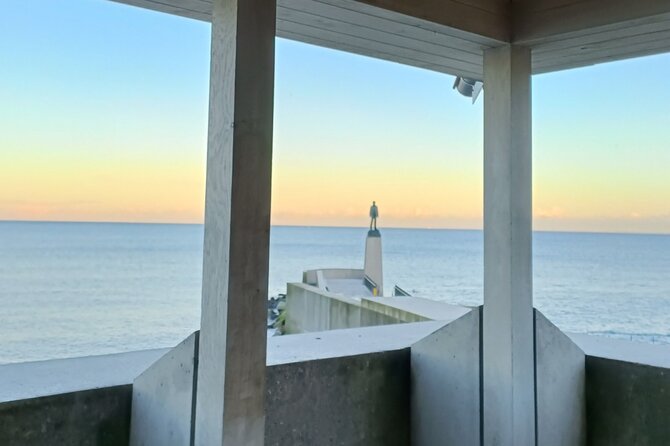
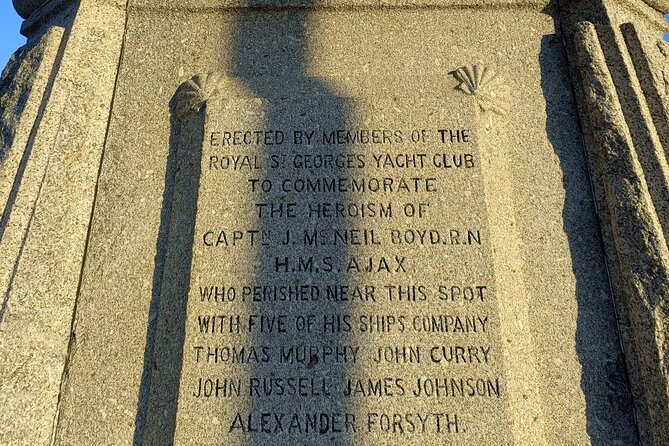
The RMS Leinster Memorial changes the tone. The ship sank during World War I, and the memorial honors those who died in one of Ireland’s deadliest maritime disasters. Here, the harbor is no longer just a pleasant place for a stroll. It becomes a setting where international conflict reached local families and a familiar Irish port.
I appreciate the inclusion of this stop because it gives the waterfront emotional weight without requiring a museum visit. You can pause, listen, and take in the connection between the memorial and the water nearby. If you prefer a purely scenic walk, this section may feel heavier than expected, but that is also its value.
Walking the Metals, an old railway route
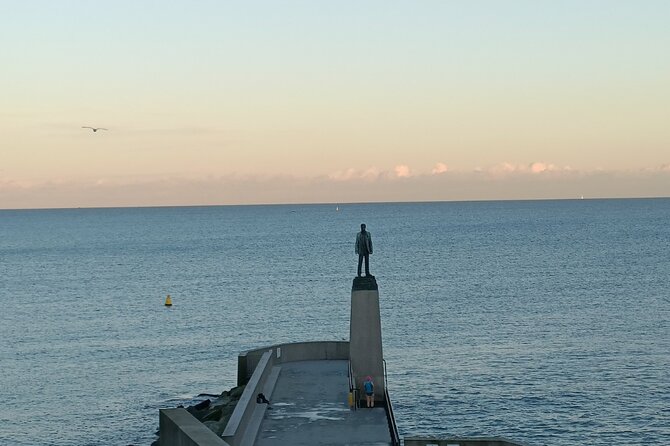
The path known as the Metals is one of the more distinctive parts of the route. It follows remnants of an old railway track that have become a promenade. The name and surviving route help explain how people and goods once moved through the area.
This is where the town’s evolution becomes easy to picture. Fishing, rail transport, port activity, and modern public space overlap in a single walk. I like stops such as this because they reveal history in the ground beneath your feet rather than in a grand monument.
The audio commentary gives the route a narrative thread, but you should expect a self-guided experience, not a live conversation. You cannot ask follow-up questions or request a shorter version on the spot. The tradeoff is simple: you receive a fixed story with complete control over your pace.
A few more Dublin trips worth weighing up
- Christ Church Cathedral Entrance Ticket & Self-Guided Tour
★ 4.6 · 773 reviews - Dublin Ghost Hunt Exploration Game and Tour
★ 4.0 · 34 reviews - Private Dublin Treasure Hunt Self Guided Tour
★ 4.5 · 14 reviews - Dublin Self-Guided Murder Mystery Tour by Temple Bar
★ 3.5 · 12 reviews
Reaching the East Pier Lighthouse

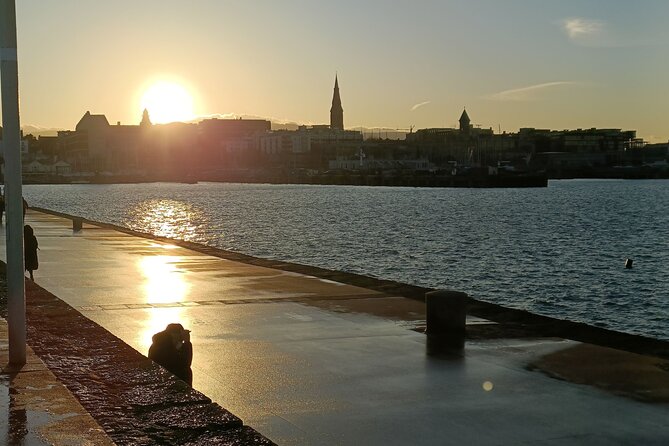
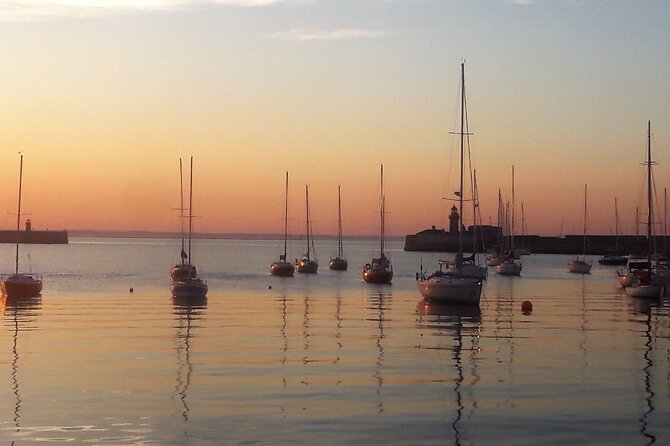
The walk along Dún Laoghaire Pier is the scenic center of the experience. As you head toward the East Pier Lighthouse, you get broad views of Dublin Bay and the city. The harbor’s long lines and open water make this the natural place to slow down.
The tour explains how the harbor was built and how it influenced Ireland’s development. The information gives the views a practical purpose. You are not looking at a pretty stretch of water in isolation. You are seeing the harbor as a piece of engineering that helped shape the town and its place in the country.
I would allow more time here than the basic one-hour estimate if the weather is pleasant. The stated duration is about one hour to one hour and 15 minutes, but audio-tour timing rarely includes every photograph, pause, or moment spent watching the water. If you have a firm appointment afterward, keep an eye on the app’s progress.
The pier is also the portion most affected by weather. The supplied information does not promise shelter or weather protection, so bring what you need for an exposed waterfront walk. You will enjoy the views more if wind or rain does not force you to hurry.
Carlisle Pier and the Forgotten Irish Memorial
Carlisle Pier dates from the 1820s and offers another view of Dún Laoghaire’s seafaring past. Its importance lies in what it represents: a town changing from a smaller coastal settlement into a port with wider connections.
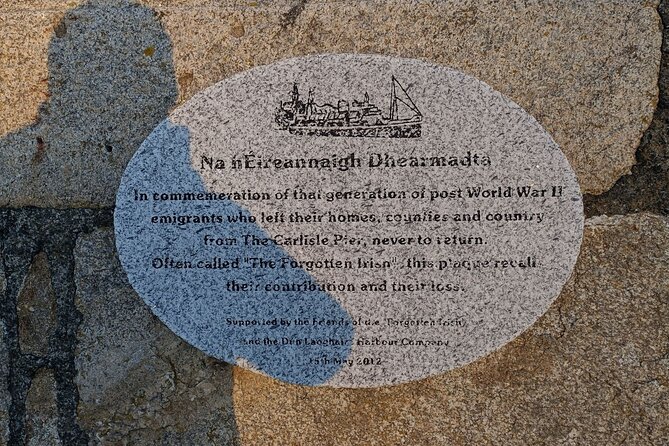
The Forgotten Irish Memorial turns that outward connection toward emigration. It honors Irish people who left home in search of new opportunities and faced the strain of building lives far away. This stop gives the walk a human scale. Harbors are places of cargo, ships, and construction, but they are also places where families said goodbye.
I find this pairing effective. Carlisle Pier explains the physical port, while the memorial points to the people whose lives were shaped by departure. You get two different ways to read the same waterfront, one through structures and one through memory.
The East Pier Bandstand Sun Shelter
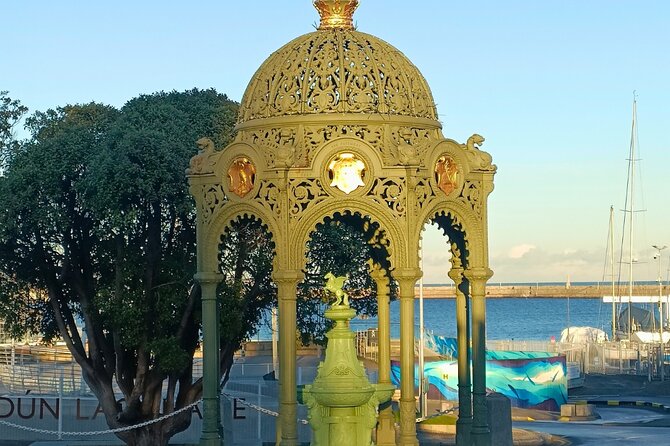
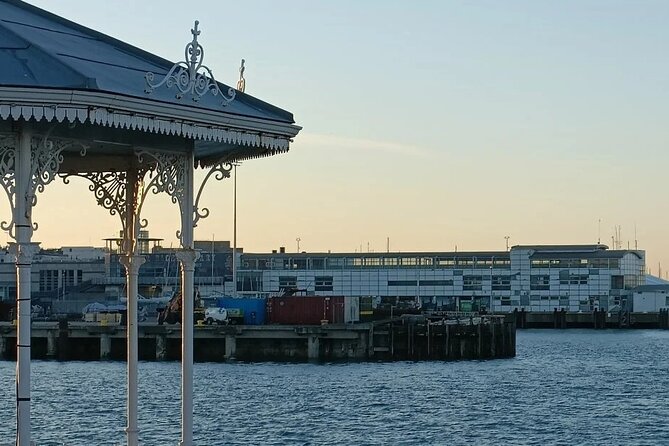
The East Pier Bandstand Sun Shelter provides a lighter architectural moment after the memorials. Its unusual design adds visual variety to the route and shows that public waterfront spaces can serve more than one purpose.
The stop is worthwhile for anyone interested in the small details of a place. You do not need a long visit, but the shelter rewards a pause to look at its form and position along the pier. The audio tour’s strength here is its ability to call attention to a feature you might otherwise pass without noticing.
This is also a good example of the route’s overall balance. The walk moves between major historical events and modest structures. You get no single grand attraction that carries the whole experience. Instead, the interest builds from several short stops.
A Romanov eagle on a Crimean War cannon
The Crimean War cannon is one of the tour’s most unusual details. Look for the eagle motif associated with the Romanov family and listen to the story of how a Russian cannon came to Dublin.
This is exactly the kind of stop that makes a self-guided walk useful. You might notice a cannon, but without context it is simply an old piece of military equipment. The audio turns it into a clue about international politics, military history, and the ways objects can travel far from their original setting.
The cannon also breaks up the solemn mood created by the ship and emigration memorials. It adds curiosity and surprise without pulling the route away from the harbor’s larger story.
Finishing near the Roger Casement Statue
The listed final point is near the Roger Casement Statue, which honors the Irish revolutionary. Its presence brings the route back to Ireland’s political story and its long struggle over identity, loyalty, and independence.
Nearby eateries give you a chance to continue the outing with food or a drink, though those purchases are not part of the tour. I like this kind of ending because it does not leave you at an isolated viewpoint. You finish in a town setting where you can keep walking or stop for a break.
The activity information says the walk ends back at the meeting point, even though the final section is described near the Roger Casement Statue. Follow the app’s directions for the exact last part of the route. This is a small point, but it matters if you are arranging transport or meeting someone afterward.
What the $8.99 price gets you
At $8.99 per person, this is inexpensive for a private walking experience with lifetime access. You are paying for the recorded route, the app, maps, and geographic data rather than for a live guide, admission tickets, transport, or refreshments.
The value is strongest if you want a structured introduction to Dún Laoghaire and may return to the area. Lifetime access means you can use the tour again, and offline material is useful if you prefer to keep data use low. You can also stop the walk and resume later, though the stated activity duration suggests it is intended as one compact outing.
The price is less attractive if you already know the harbor well or want personal explanations from a local guide. There is no guide listed by name because there is no in-person guide attached to the experience. You also cannot change the booking or receive a refund, so make sure the date and group plans suit you before paying.
A rating of 4.5 from six submitted ratings suggests a generally positive response, but the sample is small. One four-star comment uses heavily distorted auto-translated wording and mainly conveys a sense of adventure and discovery. I would treat that as a sign of enthusiasm rather than as detailed evidence about the route.
Who will get the most from this walk
I would recommend this tour to you if you enjoy history in small portions, prefer to move independently, and want a Dublin-area outing that is shorter than a full-day excursion. It suits solo visitors, couples, families with older children, and small private groups who can share the audio or listen separately.
It is also a good choice if you want to combine several subjects in one walk: maritime history, railways, emigration, wartime loss, public monuments, and Irish political memory. The route keeps changing focus, so it should hold your attention better than a simple out-and-back promenade.
You may want another option if you dislike using apps, do not have headphones, or need a fully guided conversation. The route is offered in English only. Most people can participate, and service animals are allowed, but the activity information does not provide a detailed surface or mobility assessment, so you should consider your own walking needs.
Public transportation is nearby, which makes the meeting point practical. No separate transport is included, however, and you should arrange your own way to and from Dún Laoghaire.
My verdict on the East Pier audio walk
Book this if you want an affordable, flexible introduction to Dún Laoghaire with more substance than a waterfront photo stop. The best parts are the changing subject matter, the harbor views, the Metals, and the unexpected Crimean War cannon.
Skip it if you need a live guide, a refund-friendly booking, or a tour in another language. For everyone else, $8.99 buys a well-planned hour of local history, with enough freedom to make the walk feel like your own.
FAQ
How long does the Dún Laoghaire East Pier tour take?
The stated duration is approximately one hour to one hour and 15 minutes.
What language is the tour offered in?
The tour is offered in English.
Where does the tour begin?
It begins at St Michael’s Church, Marine Road, Dún Laoghaire, County Dublin, Ireland.
Where does the tour finish?
The activity ends back at the meeting point. The final section takes you near the Roger Casement Statue before returning according to the app’s route.
Is this a guided group tour?
No. It is a private, self-guided activity, so only your group participates.
What app do I need?
You need the VoiceMap app for Android or iOS.
Can I use the tour without mobile data?
Yes. Offline access to the audio, maps, and geographic data is included.
Do I need to bring my own phone and headphones?
Yes. A smartphone and headphones are not included, so you need to supply them yourself.
Are food, drinks, or transportation included?
No. Food, drinks, and transportation are not included.
Can I cancel for a refund?
No. The experience is non-refundable and cannot be changed for any reason after booking.
Just added around Dublin
- Wicklow: Private Day Tour from Dublin★ 5.0 · 5 reviews
- Wicklow Mountains Private Day Tour including Glendalough★ 5.0 · 7 reviews
- Women Of Ireland: Trailblazers & Pioneers★ 5.0 · 4 reviews
- Wicklow Mountains & Glendalough Luxury Private Day Tour★ 5.0 · 23 reviews
- Wicklow tour of Glendalough★ 4.5 · 8 reviews
- Dublin To Kilkenny Castle Waterford Crystal Private Car – Day Tour★ 5.0 · 8 reviews
- Waterford Crystal and Kilkenny Full-Day Rail Tour from Dublin★ 5.0 · 3 reviews
- Full Day Private Wicklow Tour★ 5.0 · 12 reviews
Howth and the Dublin Coast Tours, compared.

Half-Day Guided Coastal Tour to Howth Village
Read our review →
Howth Coastal Half-Day Bus Tour from Dublin with Live Guide
Read our review →



Browse the lists this tour appears in