
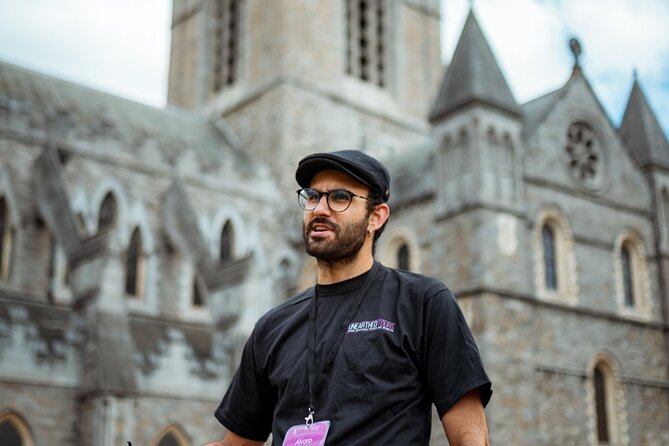
Reviewed · DUBLIN GHOST AND DARK HISTORY TOURS
Dark Dublin: Torture, Murder & Mystery
Dublin’s old streets carry plenty of grim stories, and this two-hour walk brings them out from behind the postcard views. You’ll hear about torture, cannibalism, body snatching, murder, and strange local legends while walking from Barnardo Square to Smithfield.
I like the way the tour pairs major sights such as Dublin Castle and St Patrick’s Cathedral with less obvious stops like the 40 Steps and St Audoen’s Church. I also like the guides’ lively delivery. Names frequently praised include Killian, Kim, Michael, Cillian, Mikayla, and Stephen, though your guide will depend on the date.
The main drawback is that this is a storytelling walk, not an inside tour. You do not enter Dublin Castle, St Patrick’s Cathedral, Christ Church, St Audoen’s Church, or St Michan’s Church, and traffic or a fast pace can make some stories harder to follow.
Key points to know before you book
- The route covers eight dark-history stops: Walk from Barnardo Square through Dublin Castle, the cathedral quarter, the old city, and Smithfield.
- The stories are genuinely grim: Expect tales of torture, grave robbing, cannibalism, executions, murder, and ghostly events.
- You see major sights from outside: The tour visits courtyards and church grounds, but admission inside the buildings is not included.
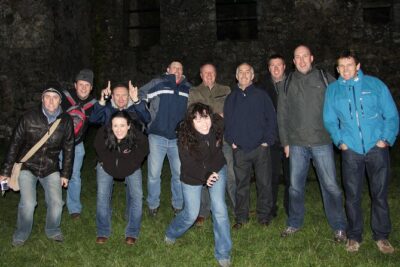
- The group can reach 30 people: It is a medium-sized walking tour, not a private experience.
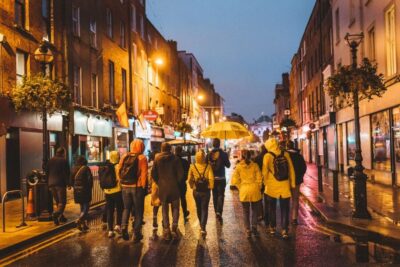
- The 5:30 pm start suits a spooky mood: You finish in Smithfield after about two hours, with the city shifting toward evening.
- The price is modest for a guided city walk: At $23.22 per person, the value comes from the stories and route rather than entry tickets.
A dark introduction at Barnardo Square
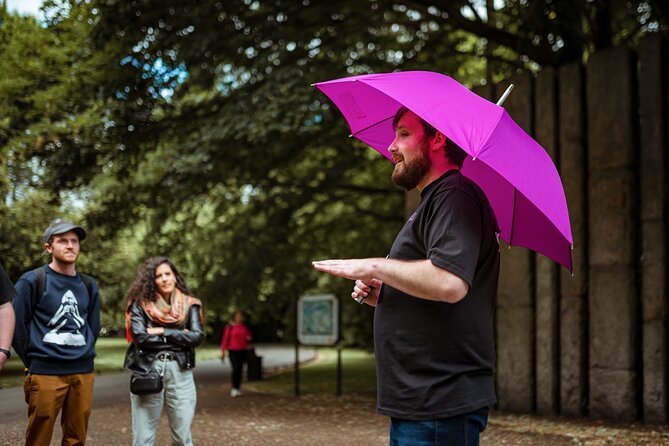
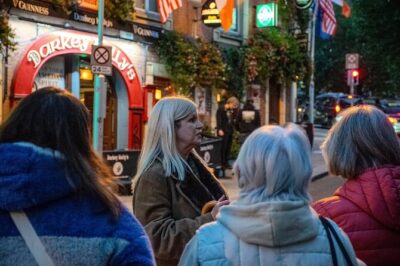
The walk begins at Barnardo Square on Dame Street, beside City Hall and opposite the Olympia Theatre. Look for the guide with a purple umbrella, a useful marker in a busy central area.
This is a practical meeting point. You are close to familiar Dublin landmarks, public transport, cafés, and places to use the toilet before setting off. The tour begins at 5:30 pm, so plan ahead for food and personal stops. Dinner is not included, and the walk finishes in Smithfield rather than returning to the start.
The first few minutes also set the tone. This is not a standard city tour with a few spooky jokes added at the end. The focus is Dublin’s unpleasant side, including the crimes, punishments, beliefs, and public fears that shaped the city.
More Dublin ghost and dark history walks:
- Dublin Ghost Bus Tour with Professional Actors
★ 4.5 · 949 reviews - The Dublin Ghostbus Tour
★ 4.6 · 634 reviews - Haunted Dublin Walking Tour
★ 5.0 · 550 reviews
Dublin Castle and the Devil’s Half Acre
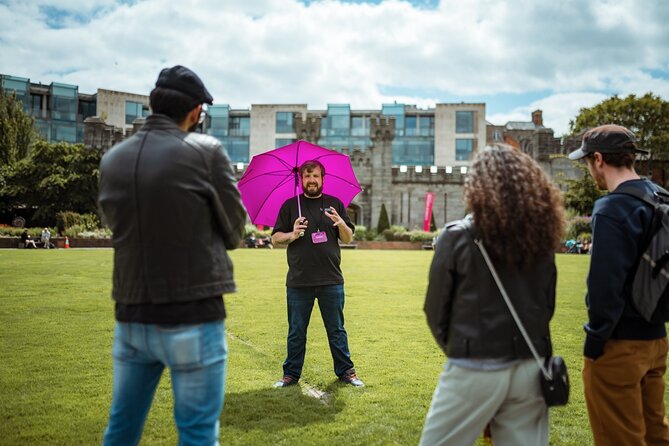
The first main stop is Dublin Castle. You walk through the Lower Courtyard, where the guide explains torture and punishment in earlier times. You then continue to the Upper Courtyard for stories linked to the Devil’s Half Acre.
The castle is one of Dublin’s key historic sights, so this stop gives you a strong sense of place even though you do not go inside. You see the courtyards and hear about what happened around them. That approach works well for anyone who has already visited the castle interiors or has limited time and wants a short introduction.
The trade-off is clear: admission to Dublin Castle is not part of the tour. If you want the formal rooms, exhibits, and state apartments, you need a separate visit. Think of this walk as an outdoor history lesson with a macabre angle, not a replacement for the castle tour.
The 40 Steps and stories of cannibalism
The stop known as the 40 Steps shifts the focus from official buildings to a darker and less familiar corner of the city. Here, the guide tells stories of cannibalism.
This is one of the places that can be hard to find without someone who knows the route. It also shows why the walk is more than a list of famous sights. Dublin’s dark past is not confined to castles and cathedrals. It appears in obscure spaces, local traditions, and stories that rarely make it into a standard sightseeing guide.
The subject matter is strong. If you prefer mild ghost stories, you may find the material too graphic or unsettling. If true crime and grim social history appeal to you, this is likely to be one of the more memorable sections.
St Patrick’s Cathedral and Jonathan Swift
The group continues to the grounds of St Patrick’s Cathedral, where the guide discusses Jonathan Swift and the cathedral’s darker associations. You do not enter the church.
This part adds a human and literary thread to the walk. Swift is often linked with Dublin’s intellectual and political life, but the tour places him within a more somber setting. The cathedral grounds also give the group a chance to pause and take in one of Dublin’s best-known religious buildings from outside.
You should expect the guide to tell the story rather than provide a formal architectural tour. The stop lasts about 15 minutes, so the content stays focused. If you want to study the cathedral’s interior, tombs, or stained glass, leave time for a separate visit.
A completely different kind of day out of Dublin:
- Dublin to Cliffs of Moher, including Wild Atlantic Way and Galway
★ 5.0 · 23,331 reviews - From Dublin: Cliffs of Moher, Burren & Galway City Day Tour
★ 4.8 · 18,888 reviews - Dublin: Guinness Storehouse Entry Ticket
★ 4.6 · 16,863 reviews - Dublin to Cliffs of Moher, Burren, Wild Atlantic Way, Galway Tour
★ 5.0 · 12,924 reviews
Christ Church Cathedral and the city beneath the surface
Christ Church Cathedral is another major stop. The guide explains the hidden and less comfortable parts of the church’s past, again without taking the group inside.
This is useful for first-time visitors because you see several central landmarks in one walk. The route does not cover every famous attraction in Dublin, especially sights on the north side of the River Liffey, but it does create a clear south-side circuit around the castle and cathedral quarter.
The route also makes a sensible choice for a two-hour tour. Trying to include all of central Dublin would mean rushing from point to point. Here, you get a focused stretch of the city, with enough time at each stop for a story rather than a quick photograph and a hurried explanation.
St Audoen’s Church and the grave robbers
At St Audoen’s Church, the subject turns to grave robbing and attacks connected with the Black Pig. The church itself is not entered, but the surrounding area gives the story a fitting setting.
Grave robbing is one of the tour’s recurring themes, and it offers more historical context than a simple ghost tale. The practice was tied to fear, money, medicine, and the treatment of the dead. Stories like this show how different everyday life could be in earlier Dublin, when burial grounds were not always places of quiet respect.
The stop is also a good example of the tour’s balance between well-known landmarks and places you might otherwise pass without noticing. You get the setting, the local story, and a reason to look more closely at the old city walls and church grounds.
St Michan’s Church and Billy in the Bowl
The next stop is St Michan’s Church, where the guide covers the brutal story of Billy in the Bowl and more recent dark events. The church is not included inside the tour.
The name alone gives this stop an unusual local character. It is not a generic haunted-house story imported from somewhere else. It is tied to Dublin and to the city’s own folklore and criminal past. The guide’s delivery matters here, since the story needs enough detail to hold your attention without becoming theatrical for its own sake.
This is also where the walking conditions may matter. The full route is described as easy walking, but one person found the pace quick for members of the group who walked more slowly. If you need a very gentle pace, tell the guide early and stay near the front or middle so you do not lose the thread of the story.
Smithfield Square and the final murder story
The walk ends at Smithfield Square after a final story about a local murderer. The square is a public space, so there is no formal exit or onward transport included.
Smithfield is a useful finish because it places you beyond the tight central sightseeing zone. You can continue exploring the area, find a meal, or use public transport from there. It also gives the tour a proper ending rather than dropping you beside the first meeting point and repeating the same streets.
The timing works well for an evening plan. You finish after roughly two hours, but the exact pace can vary with the group, street noise, weather, and questions. You may want to keep your dinner plans flexible rather than booking a restaurant at a very tight time.
Storytelling is the heart of the experience
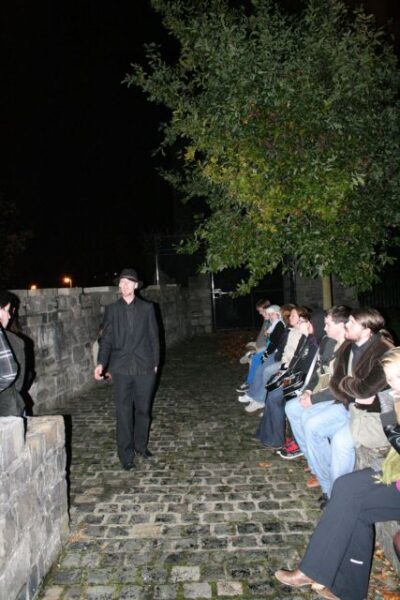
The strongest part of this tour is the guide. The route matters, but the stories only work if the person leading them can manage a group outdoors and hold attention beside traffic and passing crowds.
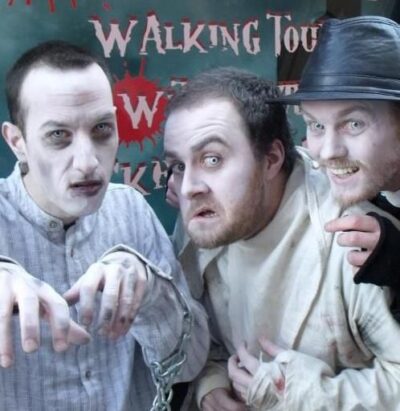
Several guides receive particular praise for combining facts with humor. Killian is described as energetic and memorable. Kim is praised for passion and clear detail. Michael is noted for friendly, engaging delivery, while Cillian is singled out for a strong sense of atmosphere. Stephen and Mikayla are also praised for keeping the walk lively.
Guide assignments can change, so you cannot book a particular person based on these names. Still, the repeated pattern is useful: the experience depends more on personality and pacing than on special effects. You should expect a live, informal presentation, not an audio guide or a scripted museum talk.
There is one practical weakness. Outdoor storytelling can be affected by traffic, crowds, rain, and street noise. One person found it hard to hear parts of the talk and felt the delivery lacked drama. Stand where you can see the guide, avoid drifting to the back, and ask for a repeat if a key detail disappears under a passing bus.
What the $23.22 price really buys you
At $23.22 per person, this is a reasonably priced way to spend an evening in Dublin. You are paying for an in-person guide, a planned route, and access to stories and locations that would be difficult to connect on your own.
You are not paying for entrance tickets, transport, food, or a private group. That matters because several stops are viewed from the outside. If your priority is entering Dublin’s historic buildings, the price will not feel like a complete sightseeing package.
For me, the value is strongest when you treat this as a themed walking tour. You get eight stops over about two hours, including major landmarks and obscure places. Group discounts may make it more appealing for families or friends, although the maximum group size is 30 people, so the word small should not be taken to mean private.
The tour is offered in English and uses a mobile ticket. Service animals are allowed, and most people can take part. There is no private transportation, so you need to arrive at Barnardo Square and make your own way home from Smithfield.
Who will enjoy this Dublin walk
I would choose this tour for you if you like:
- True crime, folklore, and unsettling local history
- Walking tours with plenty of storytelling
- Seeing famous landmarks through an unusual angle
- Exploring beyond the most obvious central streets
- A two-hour activity that fits before dinner
- A spooky evening plan in October or around Halloween
It is also a good match for a first visit if this is your only organized Dublin tour. You see Dublin Castle, St Patrick’s Cathedral, Christ Church Cathedral, and other old-city locations in one route, while learning details you are unlikely to find in a basic guidebook.
I would hesitate to recommend it if you dislike graphic subjects. Torture, murder, cannibalism, executions, grave robbing, and disturbing folklore are central to the experience, not occasional side notes. You should also choose another activity if you need indoor shelter, a very slow pace, or guaranteed quiet at every stop.
Practical advice for making the walk easier
Wear shoes suited to two hours on city streets. The walking is described as easy, but you will be on your feet and moving between several locations.
Arrive a little early at Barnardo Square and look for the purple umbrella. The meeting point is beside City Hall, opposite the Olympia Theatre, so it should be straightforward to locate, but a busy street is not the place to arrive at the last second.
Use the toilet and pick up a snack before the start. The guide may offer useful practical advice at the beginning, but dinner is not part of the tour. Since the finish is in Smithfield, you can plan a meal afterward without retracing the route.
Keep an eye on the guide’s position. Street noise can interfere with the stories, especially if you hang back. The group may include people who walk at different speeds, and one account found the pace brisk, so mention any mobility concern before the walk gets underway.
The cancellation terms are simple: cancel at least 24 hours before the 5:30 pm start for a full refund. Changes or cancellations inside 24 hours are not refunded, and the provider may offer another date or a full refund if the minimum number needed to run the tour is not reached.
Should you book Dark Dublin?
Book it if you want Dublin history with a grim edge, especially if murder, folklore, torture, and grave robbing sound more interesting than a standard monument tour. The route covers important sights, but its real purpose is to change the way you see them.
Skip it if you want to go inside the cathedrals and castle, or if you prefer polished sightseeing with little disturbing detail. At $23.22, the price is fair for a lively two-hour walk, but the value rests on the guide’s storytelling and your interest in dark subject matter.
For the right person, this is a memorable way to spend an evening. Arrive ready for gruesome tales, stay close enough to hear, and leave time for dinner in Smithfield afterward.
FAQ
Where does Dark Dublin begin?
The tour begins at Barnardo Square on Dame Street in Dublin 8, beside City Hall and opposite the Olympia Theatre.
What time does the tour start?
The scheduled start time is 5:30 pm.
Where does the tour finish?
The walk finishes at Smithfield Square, at 7 Smithfield, Dublin.
How long does the tour last?
The tour lasts approximately two hours.
What sights are included on the route?
The route includes Barnardo Square, Dublin Castle, the 40 Steps, St Patrick’s Cathedral, Christ Church Cathedral, St Audoen’s Church, St Michan’s Church, and Smithfield Square.
Do you enter Dublin Castle?
No. The guide visits the Lower Courtyard and Upper Courtyard, but admission inside Dublin Castle is not included.
Do you enter the churches and cathedrals?
No. The tour visits the grounds or exterior areas of St Patrick’s Cathedral, Christ Church Cathedral, St Audoen’s Church, and St Michan’s Church without entering the buildings.
What subjects does the guide cover?
The stories include torture, murder, cannibalism, grave robbing, executions, body snatching, ghost stories, Jonathan Swift, Billy in the Bowl, and other dark events from Dublin’s past.
How large is the group?
The tour can have a maximum of 30 people. It is described as a medium-group walking tour rather than a private tour.
Is the tour available in English?
Yes. The tour is offered in English and includes an in-person guide.
Just added around Dublin
- Wicklow: Private Day Tour from Dublin★ 5.0 · 5 reviews
- Wicklow Mountains Private Day Tour including Glendalough★ 5.0 · 7 reviews
- Wicklow Mountains & Glendalough Luxury Private Day Tour★ 5.0 · 23 reviews
- Wicklow tour of Glendalough★ 4.5 · 8 reviews
- Women Of Ireland: Trailblazers & Pioneers★ 5.0 · 4 reviews
- Waterford Crystal and Kilkenny Full-Day Rail Tour from Dublin★ 5.0 · 3 reviews
- Full Day Private Wicklow Tour★ 5.0 · 12 reviews
- Dublin To Kilkenny Castle Waterford Crystal Private Car – Day Tour★ 5.0 · 8 reviews
Dublin Ghost and Dark History Tours, compared.

Hidden Dublin: Haunted History Walking Tour v2.0 2026
Read our review →
Browse the lists this tour appears in